

Global vs Local Sourcing: Which Strategy Actually Saves More Cost?
Struggling with global vs local sourcing? Compare costs, lead times, risks, and explore real-world examples to choose the right strategy for your supply chain success.
Supply Chain Navigator
5/24/20268 min read
In today’s highly competitive and interconnected business environment, sourcing decisions play a critical role in determining cost efficiency, product quality, and supply chain resilience. One of the most debated topics in procurement and supply chain management is global sourcing vs local sourcing.
Should businesses source materials and products from international suppliers to reduce costs? Or should they prioritize local suppliers for faster delivery and reliability?
This guide provides a comprehensive comparison of local vs global sourcing, helping you understand the advantages, disadvantages, and best use cases for each approach. Before diving deeper, it’s important to understand the fundamentals of procurement in supply chain management.


What is Global Sourcing?
Global sourcing refers to procuring goods and services from suppliers located in different countries. Companies adopt global sourcing to leverage cost advantages, access specialized skills, and expand their supplier base.
For example, many companies source raw materials from China, electronics from Taiwan, and textiles from Bangladesh to reduce manufacturing costs.
Key Features of Global Sourcing:
Access to international suppliers
Lower production and labor costs
Availability of specialized products
Economies of scale
What is Local Sourcing?
Local sourcing, on the other hand, involves procuring goods and services from suppliers within the same country or region. Businesses that prioritize local sourcing often focus on faster delivery, better quality control, and supporting the local economy.
Key Features of Local Sourcing:
Shorter supply chains
Faster delivery times
Easier communication and coordination
Stronger supplier relationships
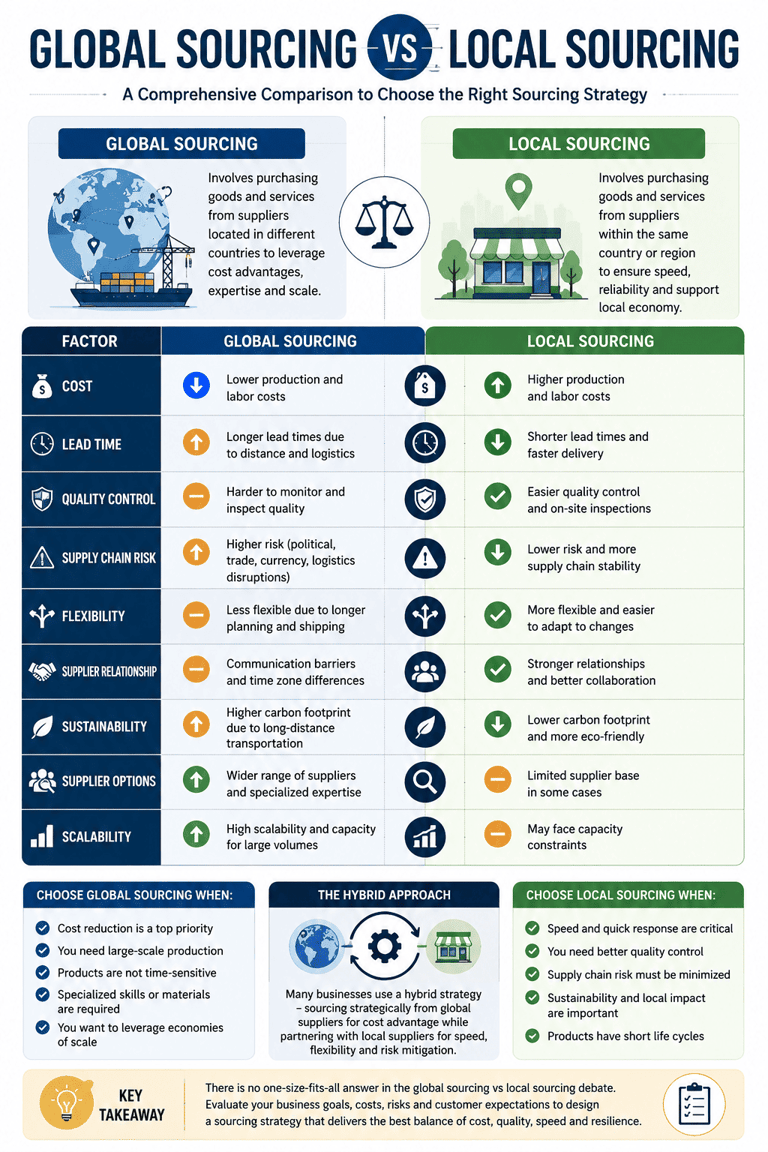
Global vs Local Sourcing: Key Differences
Understanding the differences between global vs local sourcing is essential for making informed procurement decisions.
To measure sourcing performance effectively, tracking the right procurement metrics is essential
Advantages of Global Sourcing
1. Cost Reduction
One of the most compelling reasons businesses turn to global sourcing is the potential for significant cost savings. By sourcing products from countries with lower labor costs and more affordable production expenses, companies can reduce overall procurement costs. These savings can be reinvested into innovation, marketing, or expansion, strengthening long-term competitiveness.
2. Access to Specialized Skills
Global sourcing opens doors to regions that have developed deep expertise in specific industries. For example:
Precision manufacturing in Germany
Electronics in East Asia
Textiles in South Asia
By tapping into these specialized skill sets, businesses gain access to advanced technologies, craftsmanship, and innovation that may not be available locally.
3. Scalability
Global suppliers often operate at a scale that local vendors cannot match. Their ability to handle large-volume production ensures that businesses can ramp up operations quickly to meet rising demand. This scalability is particularly valuable for companies experiencing rapid growth or seasonal spikes in sales.
4. Competitive Advantage
Lower sourcing costs translate directly into stronger market positioning. Businesses can:
Offer competitive pricing to attract cost-conscious customers.
Improve margins without sacrificing quality.
Expand into new markets with affordable products.
This advantage often becomes a differentiator, allowing companies to outpace rivals who rely solely on local sourcing.
Disadvantages of Global Sourcing
1. Longer Lead Times
International shipping is rarely fast. Goods must travel across oceans, clear customs, and pass through multiple checkpoints. These extended timelines can complicate inventory planning and make it harder to respond quickly to sudden changes in customer demand.
2. Supply Chain Risks
Global sourcing exposes businesses to a wide range of external risks, including:
Political instability that disrupts production or trade.
Trade restrictions such as tariffs or embargoes.
Currency fluctuations that impact cost predictability.
Port delays and logistical bottlenecks.
These risks can quickly erode the cost advantages that global sourcing promises.
3. Communication Barriers
Working across languages, cultures, and time zones often leads to misunderstandings. Scheduling meetings across continents can be challenging, and language differences may slow down negotiations or cause errors in documentation.
4. Quality Control Issues
Ensuring consistent quality from overseas suppliers requires significant effort. Inspections, audits, and compliance checks are harder to manage remotely, and the costs of monitoring can add up quickly. This makes quality assurance a persistent challenge.
Advantages of Local Sourcing
1. Faster Delivery
Local sourcing shortens lead times dramatically. Products can move quickly from supplier to warehouse to customer, enabling businesses to respond rapidly to market shifts and urgent orders.
2. Better Quality Control
Proximity allows businesses to conduct regular inspections and maintain tighter oversight. This hands‑on approach ensures higher consistency and makes it easier to resolve issues before they escalate.
3. Reduced Risk
Compared to global sourcing, local sourcing minimizes exposure to geopolitical tensions, customs delays, and international logistics challenges. This makes supply chains more predictable and resilient.
4. Strong Supplier Relationships
Working closely with local suppliers fosters trust, collaboration, and long‑term partnerships. These relationships often translate into better service, flexibility, and shared growth opportunities.
5. Sustainability Benefits
Shorter transportation routes mean fewer emissions. Local sourcing supports eco‑friendly practices and helps businesses align with sustainability goals, which are increasingly valued by customers.
Disadvantages of Local Sourcing
1. Higher Costs
One of the biggest drawbacks is price. Local suppliers often face higher labor and production costs, which can make their products more expensive compared to global alternatives.
2. Limited Supplier Base
Depending on the industry, businesses may find fewer options when sourcing locally. This limited pool can restrict innovation and bargaining power.
3. Capacity Constraints
Local suppliers may not always have the infrastructure or scale to meet large‑volume demand. This can be a challenge for businesses experiencing rapid growth or seasonal spikes.
Local vs Global Sourcing: When to Choose Each?
Choosing between local vs global sourcing depends on your business priorities.
Choose Global Sourcing When:
Cost reduction is a top priority
You need large-scale production
Products are not time-sensitive
Specialized skills are required
Choose Local Sourcing When:
Speed and flexibility are critical
You need better quality control
Supply chain risk must be minimized
Sustainability is a priority
Hybrid Sourcing Strategy: The Best of Both Worlds
Many companies today are moving towards a hybrid sourcing strategy in supply chain management, combining both global and local sourcing. This approach helps businesses balance cost, risk, and flexibility - as explained in our detailed hybrid sourcing strategy guide.
Example:
Source raw materials globally (cost advantage)
Manufacture or assemble locally (speed and control)
This approach helps businesses balance cost efficiency with supply chain resilience.
Impact of Global Events on Sourcing Decisions
Recent global disruptions such as pandemics, geopolitical conflicts, and shipping crises have reshaped sourcing strategies. Businesses are increasingly shifting from purely global sourcing to a mix of local and global sourcing to reduce dependency on a single region.
This shift highlights the importance of flexibility in procurement strategies.
Key Factors to Consider Before Choosing a Sourcing Strategy
Selecting between global sourcing and local sourcing isn’t just about comparing prices. It’s about weighing multiple dimensions that shape the efficiency, resilience, and competitiveness of your supply chain. Let’s break down the critical factors:
1. Total Cost (Beyond Unit Price)
It’s easy to be tempted by lower unit costs overseas, but the true cost picture includes:
Logistics expenses such as freight, warehousing, and inland transportation.
Duties and tariffs that vary by country and trade agreements.
Inventory holding costs when longer lead times force you to stockpile goods.
A holistic cost analysis often reveals that the cheapest supplier isn’t always the most economical choice.
2. Lead Time Requirements
Speed matters. Industries like fast fashion or electronics thrive on rapid product cycles. Local sourcing can shorten lead times dramatically, enabling:
Faster replenishment
Quicker response to market trends
Reduced risk of stockouts
Global sourcing, while cost-effective, may struggle to keep pace with industries where agility is key.
3. Risk Tolerance
Every supply chain faces risks—political instability, currency fluctuations, natural disasters, or pandemics. Ask yourself:
How much disruption can your business absorb?
Do you have contingency plans like dual sourcing or nearshoring?
Companies with low risk tolerance often prefer local or regional suppliers to minimize exposure.
4. Supplier Reliability
A supplier’s track record can make or break your operations. Evaluate:
On-time delivery performance
Quality consistency
Financial stability
Global suppliers may offer scale, but local partners often provide stronger relationships and easier collaboration.
5. Market Demand Variability
Demand rarely stays constant. In industries with high fluctuations:
Flexible sourcing strategies are essential.
Local suppliers can ramp up or scale down quickly.
Global suppliers may struggle with responsiveness due to distance and bureaucracy.
Balancing both models—using global sourcing for stable demand and local sourcing for volatile demand—can be a winning approach.
In practice, many businesses adopt a hybrid sourcing strategy, blending global cost advantages with local agility. The right mix depends on your industry, customer expectations, and long-term growth goals.
Real‑World Examples of Sourcing Strategies
Theory is useful, but sourcing strategies really come alive when you see how industries apply them in practice. Let’s look at three common approaches:
1. Global Sourcing
Electronics companies often rely on global sourcing to keep costs competitive.
Example: Many smartphone manufacturers source semiconductors, circuit boards, and batteries from Asia, where specialized suppliers and economies of scale drive down production costs.
Benefit: Lower unit costs and access to advanced technology.
Challenge: Longer lead times and exposure to geopolitical risks.
Global sourcing works best when cost savings outweigh the risks of distance and complexity.
2. Local Sourcing
Food and beverage companies frequently choose local sourcing to ensure freshness and reliability.
Example: A dairy brand sources milk from nearby farms to guarantee freshness and reduce transportation time.
Benefit: Faster delivery, better quality control, and stronger supplier relationships.
Challenge: Higher costs compared to global alternatives, and limited scalability.
Local sourcing is ideal for industries where speed, freshness, and trust matter more than cost savings.
3. Hybrid Approach
Automotive companies often blend global and local sourcing to balance efficiency with responsiveness.
Example: Car manufacturers source parts like engines or electronics globally but assemble vehicles locally to meet regional demand and comply with regulations.
Benefit: Cost efficiency from global suppliers combined with agility from local assembly.
Challenge: Requires strong coordination across multiple supply chain layers.
The hybrid model is increasingly popular because it offers resilience—leveraging global scale while staying close to customers. These strategies directly impact warehouse operations and logistics performance
Future Trends in Sourcing
The conversation around global sourcing versus local sourcing is shifting rapidly as businesses adapt to new realities. Emerging trends are redefining how companies design their supply chains, focusing not only on cost but also on resilience, sustainability, and agility.
1.Nearshoring
Nearshoring is gaining momentum as companies move production closer to their primary markets. Instead of relying solely on distant suppliers, businesses are relocating manufacturing to neighboring countries or regions. This approach reduces transportation costs, shortens lead times, and minimizes exposure to global disruptions such as port congestion or geopolitical tensions. For example, U.S. firms increasingly look to Mexico as a nearshoring hub, balancing affordability with proximity. The result is a supply chain that is faster, more responsive, and better aligned with customer expectations.
2.Digital Procurement
Technology is transforming procurement from a transactional function into a strategic powerhouse. With tools like AI, blockchain, and predictive analytics, companies gain real‑time visibility into supplier performance, pricing, and risk factors. Digital procurement platforms allow managers to make smarter, data‑driven decisions, improving transparency and reducing fraud. As these systems evolve, procurement will no longer be about simply buying goods—it will become a central hub for collaboration, innovation, and long‑term supplier relationships.
3.Sustainable Sourcing
Sustainability is no longer a buzzword; it’s becoming a core requirement in sourcing strategies. Businesses are prioritizing eco‑friendly practices, from sourcing renewable materials to reducing carbon footprints and partnering with socially responsible suppliers. Consumer demand for ethical products, combined with stricter government regulations, is pushing companies to embed sustainability into their supply chain KPIs. In the future, success will be measured not only by cost savings but also by environmental impact and social responsibility.
4.Supply Chain Diversification
The risks of over‑reliance on a single region have become clear in recent years. Whether it’s Asia’s dominance in electronics or Europe’s role in specialty manufacturing, disruptions in one area can ripple across the globe. To counter this, businesses are diversifying their supplier base across multiple geographies. This strategy reduces vulnerability to geopolitical tensions, natural disasters, or pandemics, while creating a more resilient supply chain. Diversification often means blending global, local, and regional sourcing to strike the right balance between efficiency and security.
Conclusion
The choice between global sourcing vs local sourcing is not a one-size-fits-all decision. Each approach has its own advantages and challenges.
Global sourcing offers cost savings and scalability
Local sourcing provides speed, reliability, and better control
The most effective strategy for modern businesses is often a balanced approach that combines both.
By carefully evaluating your business needs, risk tolerance, and operational goals, you can build a sourcing strategy that enhances efficiency, reduces costs, and strengthens your supply chain.
Frequently asked questions
What is the main difference between global and local sourcing?
Global sourcing involves procuring from international suppliers, while local sourcing focuses on domestic suppliers.
Which is better: local vs global sourcing?
It depends on your priorities—cost vs speed, risk vs flexibility.
Why are companies shifting towards local sourcing?
To reduce supply chain risks and improve responsiveness.
Can businesses use both strategies?
Yes, a hybrid approach is increasingly common.