

Warehouse KPI Guide: Metrics, Dashboard & Examples (2026)
Learn the most important warehouse KPI, key metrics, dashboard setup, and real examples to boost efficiency, improve accuracy, and reduce operational costs effectively.
Supply Chain Navigator
5/22/20267 min read
Warehouses are no longer just storage spaces—they are critical engines of modern supply chains. Whether you run an e-commerce fulfillment center or a manufacturing warehouse, tracking the right warehouse KPIs - (Learn how this connects with effective inventory control in our Inventory Management Guide) can directly impact efficiency, cost, and customer satisfaction.
In this comprehensive guide, we’ll cover everything you need to know about warehouse KPI metrics, including dashboards, examples, and role-based KPIs for managers and supervisors.
What is a Warehouse KPI?
A warehouse KPI is a measurable value that helps evaluate how efficiently a warehouse operates. These indicators provide insights into productivity, accuracy, cost control, and service quality.
Tracking the right KPIs allows businesses to:
Improve operational efficiency
Reduce errors and costs
Enhance customer satisfaction
Why Are KPIs Important for Warehouses?
KPIs act as the compass for warehouse management. Without them, teams often make decisions based on assumptions, leading to inefficiencies, missed targets, and rising costs. But when KPIs are defined and tracked, every aspect of the warehouse—from inventory accuracy to order fulfillment speed—becomes measurable and manageable.
By setting the right KPIs, you can:
Identify bottlenecks in processes before they escalate.
Improve labor productivity by tracking performance metrics.
Enhance customer satisfaction through faster, more reliable deliveries (and even smoother returns with optimized reverse logistics strategies).
Optimize inventory levels to reduce carrying costs and avoid stockouts.
Drive continuous improvement by using data trends to refine operations.
In short, KPIs transform warehouse management from reactive firefighting into proactive, strategic control. They don’t just measure performance—they empower smarter decisions that directly impact efficiency, cost savings, and customer experience.
Top Warehouse KPI Metrics You Must Track
Running a warehouse without KPIs is like driving without a dashboard—you’re moving, but you don’t know if you’re on track. The right KPIs give you visibility, control, and the ability to make smarter decisions. Let’s break down the most important metrics every business should monitor.
1. Inventory Accuracy
Definition: Measures how closely physical inventory matches system records.
Formula: Inventory Accuracy = (Correct Inventory / Total Inventory) × 100
Why it matters: Inaccurate records lead to stockouts, overstocking, and frustrated customers. High accuracy ensures reliable planning, better forecasting, and smoother supply chain operations.
2. Order Picking Accuracy
Definition: Tracks how accurately orders are picked and shipped.
Why it matters: Even small errors—like shipping the wrong size or product—can result in costly returns and unhappy customers. High picking accuracy boosts customer satisfaction and reduces reverse logistics costs.
3. Order Cycle Time
Definition: The total time taken from order placement to delivery.
Why it matters: Shorter cycle times mean faster fulfillment and happier customers. Tracking this KPI helps identify bottlenecks in processing, packing, or shipping.
4. Inventory Turnover
Definition: Indicates how often inventory is sold and replaced in a given period.
Why it matters: A high turnover rate means products are moving quickly, reducing holding costs. A low turnover rate signals slow‑moving stock that ties up capital and warehouse space.
5. Warehouse Capacity Utilization
Definition: Measures how efficiently warehouse space is used.
Why it matters: Poor utilization leads to wasted space and higher costs. Optimizing layout, racking, and slotting can maximize capacity without expanding physical infrastructure.
6. On-Time Shipping Rate
Definition: Tracks how many orders are shipped within the promised time frame.
Why it matters: Timely shipping builds trust and loyalty. Delays damage reputation and can lead to penalties in B2B contracts.
7. Labor Productivity
Definition: Measures output per worker or labor hour.
Why it matters: Labor is one of the biggest warehouse costs. Tracking productivity helps balance workloads, identify training needs, and improve efficiency without overburdening staff.
8. Return Rate
Definition: Indicates the percentage of returned orders.
Why it matters: High return rates often point to picking errors, product quality issues, or inaccurate descriptions. Reducing returns saves costs and improves customer trust. Focus on reducing returns using reverse logistics.
Warehouse KPI Dashboard: Turning Data into Insights
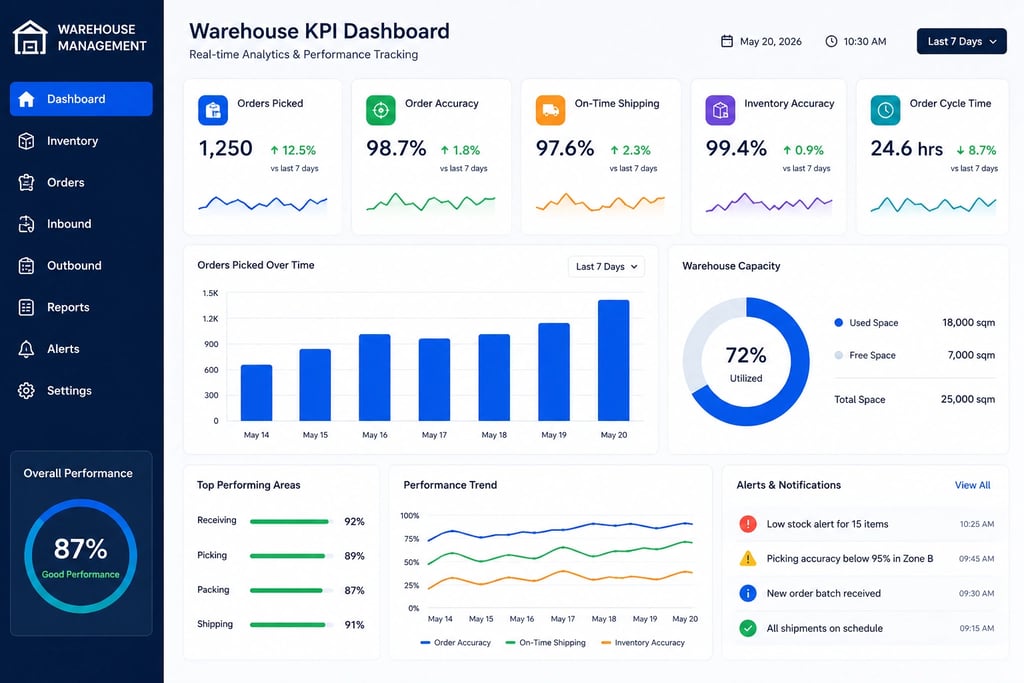
A warehouse KPI dashboard is more than just a screen full of numbers—it’s the heartbeat of your operations. It visually represents your key metrics in real time, helping managers spot trends, detect issues early, and uncover opportunities for improvement.
When designed well, a dashboard becomes a decision‑making powerhouse, offering instant clarity on what’s working and what needs attention.
What Should a KPI Dashboard Include
A strong dashboard focuses on the metrics that truly drive performance. Here’s what it should display:
Real‑time inventory levels — Know exactly what’s in stock, what’s running low, and what’s overstocked.
Order fulfillment status — Track every order from picking to shipping to ensure smooth delivery.
Labor productivity metrics — Measure efficiency per worker or shift to optimize workforce planning.
Error and return rates — Identify recurring mistakes and quality issues before they impact customers.
Space utilization data — Visualize how effectively warehouse space is being used to avoid congestion or underuse.
Benefits of Using a Dashboard
Implementing a KPI dashboard transforms warehouse management from reactive to proactive.
Faster decision‑making — Managers can act instantly on real‑time insights.
Improved visibility — Everyone—from floor supervisors to executives—sees the same data.
Easier performance tracking — Compare daily, weekly, or monthly trends effortlessly.
Data‑driven strategy planning — Use analytics to forecast demand, allocate resources, and set realistic goals.
A well‑built KPI dashboard doesn’t just display data—it tells a story. It connects warehouse performance to business outcomes, empowering teams to make smarter, faster, and more confident decisions.
KPI for Warehouse: Department‑Wise Breakdown
Every warehouse operates like a well‑oiled machine, with each department playing a unique role. To keep everything running smoothly (see how this fits into overall warehousing and distribution strategy), you need department‑specific KPIs that measure performance precisely where it matters.
Receiving KPIs
When goods arrive, efficiency and accuracy are everything.
Dock‑to‑stock time: Measures how quickly items move from receiving docks to storage shelves.
Receiving accuracy: Tracks how correctly shipments match purchase orders.
Putaway time: Evaluates how fast items are stored in their designated locations.
💡 Goal: Reduce delays and ensure inventory is ready for picking faster.
Storage KPIs
Storage KPIs help you understand how efficiently space and capital are used.
Inventory turnover: Indicates how often stock is sold and replenished.
Space utilization: Measures how effectively warehouse capacity is used.
Carrying cost: Tracks the cost of holding inventory over time.
💡 Goal: Maximize space and minimize idle stock.
Picking KPIs
Picking is where speed meets precision.
Picking accuracy: Ensures the right items are selected for each order.
Picking rate: Measures how many items or orders are picked per hour.
Order fulfillment speed: Tracks how quickly orders move from picking to shipping.
💡 Goal: Deliver flawless orders at lightning speed.
Shipping KPIs
Shipping KPIs reflect how well your warehouse delivers on promises.
On‑time shipment rate: Percentage of orders shipped within the committed timeframe.
Shipping accuracy: Ensures correct items reach the right customers.
Order cycle time: Measures total time from order placement to delivery.
💡 Goal: Build trust through timely, error‑free deliveries.
Warehouse KPI Examples (Real‑World Use Cases)
Understanding theory is one thing—seeing real warehouse KPI examples makes it practical.
Example 1: E-commerce Warehouse
KPI: Order Picking Accuracy
Target: 99.5%
Result: Reduced returns by 20%
Example 2: Manufacturing Warehouse
KPI: Inventory Turnover
Target: 8 times/year
Result: Lower storage costs and improved cash flow
Example 3: 3PL Warehouse
KPI: On-Time Shipping Rate
Target: 98%
Result: Improved client retention
Warehouse Supervisor KPI: What Should Be Measured?
Supervisors keep daily operations running smoothly. Their KPIs focus on team performance and execution.
Key Supervisor KPIs:
Team productivity (orders per hour)
Picking and packing accuracy
Attendance and labor efficiency
Safety compliance rate
Daily order completion rate
💡 Why it matters: Supervisors are the backbone of execution—strong KPIs ensure consistency and accountability.
Warehouse Manager KPI: Strategic Performance Indicators
Managers take a broader view—focusing on optimization, cost control, and long‑term growth.
Key Manager KPIs:
Operational cost
Inventory accuracy rate
Warehouse capacity utilization
Order cycle time
Customer satisfaction score
Focus Areas:
Cost reduction
Process optimization
Technology implementation
Long‑term planning
KPI Warehouse Goals and Objectives
Setting clear goals ensures your KPIs drive measurable success.
SMART KPI Goals: Your KPIs should be:
Specific
Measurable
Achievable
Relevant
Time‑bound
Example Goals:
Improve picking accuracy from 97% → 99% in 3 months
Reduce order cycle time by 20% in 6 months
Increase inventory turnover by 15% annually
How to Choose the Right Warehouse KPIs
Not every metric fits every business. Choose KPIs that align with your strategy.
Align with business goals
Focus on actionable metrics
Keep it simple
Use technology
💡 Tip: A Warehouse Management System (WMS) automates KPI tracking and reporting.
Common Mistakes to Avoid
Avoid these pitfalls when implementing KPIs:
Tracking too many metrics
Ignoring data accuracy
Not updating KPIs regularly
Lack of team alignment
Focusing only on short‑term results
How to Improve Warehouse KPIs
Implement automation — Use barcode scanning, RFID, and WMS systems.
Train your workforce — Skilled staff boost accuracy and speed.
Optimize layout — Reduce travel time and improve picking efficiency.
Use data analytics — Identify bottlenecks and inefficiencies.
Future Trends in Warehouse KPIs
The next generation of KPIs will be powered by technology:
AI‑powered analytics
Real‑time IoT tracking
Predictive performance metrics
Robotics and automation KPIs
Businesses that embrace these innovations will gain a competitive edge through smarter, faster, and more adaptive operations.
Conclusion
Tracking the right warehouse KPIs is essential for optimizing operations, reducing costs, and improving customer satisfaction. From basic metrics like inventory accuracy to advanced dashboard analytics, KPIs provide the insights needed to run a high-performing warehouse.
Whether you're a supervisor managing daily operations or a manager focusing on strategy, implementing the right KPIs can transform your warehouse into a data-driven powerhouse.
Frequently asked questions
What are the most important warehouse KPIs to track?
The most important warehouse KPIs include inventory accuracy, order picking accuracy, order cycle time, inventory turnover, warehouse capacity utilization, and on-time shipping rate. These metrics help measure efficiency, accuracy, and overall warehouse performance.
How do you measure warehouse performance?
Warehouse performance is measured using KPIs such as order accuracy, fulfillment speed, labor productivity, and inventory turnover. Using a warehouse KPI dashboard helps track these metrics in real time for better decision-making.
What is a warehouse KPI dashboard?
A warehouse KPI dashboard is a visual tool that displays key performance metrics like inventory levels, order accuracy, and shipping performance in real time. It helps managers monitor operations and identify areas for improvement quickly.
What is a good inventory accuracy rate in a warehouse?
A good inventory accuracy rate is typically between 98% and 99.5%. High accuracy reduces stock discrepancies, improves order fulfillment, and minimizes losses.
How many KPIs should a warehouse track?
A warehouse should typically track 8–12 key KPIs. Tracking too many can create confusion, while too few may not provide enough insights for performance improvement.