Warehousing in Supply Chain: Complete Guide with examples (2026)
Struggling with inventory and storage? Unlock the power of warehousing in supply chain! Explore types, key functions, real-world examples, and expert tips in this complete 2026 guide.
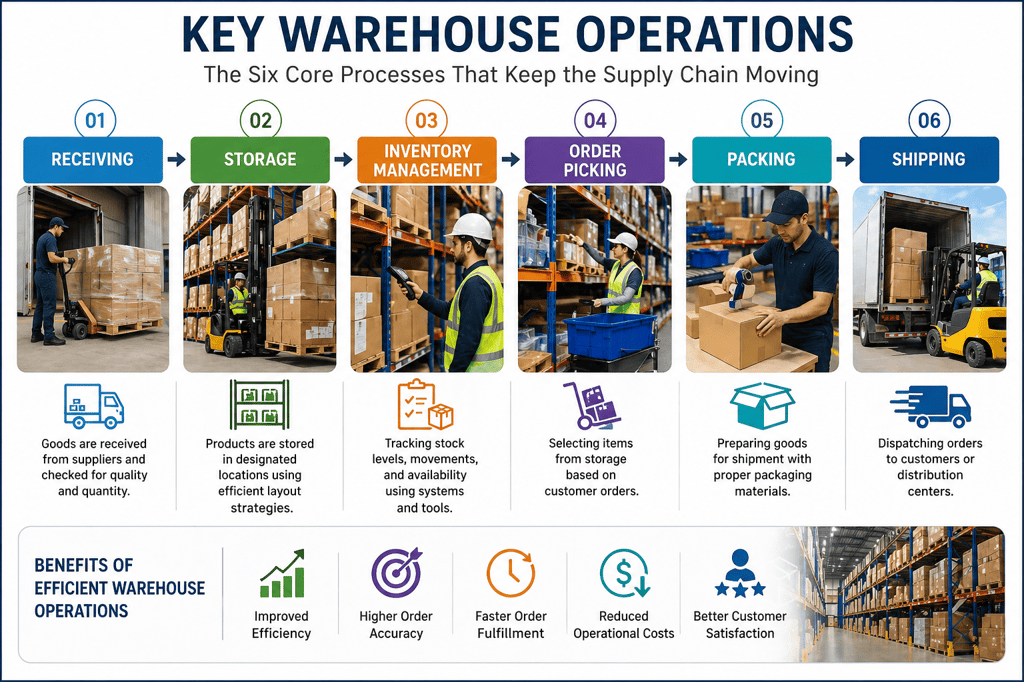
What is Warehousing in Supply Chain?
Imagine ordering a product online and receiving it within 24 hours. Behind this seamless experience is a well-organized warehousing system that ensures products are stored, managed, and delivered efficiently.
Warehousing in supply chain is no longer just about storage—it plays a critical role in inventory management, order fulfillment, and customer satisfaction.
Importance of Warehousing in Supply Chain
Warehousing is essential for maintaining a smooth and responsive supply chain. Here are the key reasons why it matters:
1. Ensures Product Availability
Warehouses play a critical role in ensuring continuous product availability for businesses. By storing goods in advance, companies can meet customer demand without delays, even when production cycles are inconsistent or suppliers face disruptions. This is especially important in industries where lead times are long or raw materials are sourced globally. Warehousing acts as a buffer between production and consumption, helping businesses avoid stockouts that could lead to lost sales and dissatisfied customers.
Additionally, maintaining optimal inventory levels in warehouses allows businesses to respond quickly to customer orders, improving service reliability. Advanced inventory management systems further enhance this capability by tracking stock levels in real time, enabling timely replenishment. Warehouses also support safety stock practices, where extra inventory is kept to handle unexpected demand or supply chain disruptions. Overall, product availability through warehousing ensures operational continuity and builds trust with customers by consistently meeting their expectations.
2. Supports Demand Fluctuations
Demand in most markets is rarely stable—it changes due to seasonality, trends, promotions, or unexpected external factors. Warehouses help businesses manage these fluctuations effectively by allowing them to store excess inventory during periods of low demand and utilize it during peak seasons. For example, retailers often stock up goods well before festive seasons or major sales events to ensure they can handle increased customer orders.
Warehousing provides flexibility in supply chain planning by decoupling production from demand. Manufacturers can produce goods at a steady rate while warehouses absorb the variability in demand. This prevents production bottlenecks and avoids the need for costly last-minute manufacturing or expedited shipping. Moreover, businesses can use demand forecasting techniques alongside warehousing strategies to optimize stock levels and reduce waste or overstocking.
In essence, warehouses act as shock absorbers in the supply chain, balancing supply and demand efficiently. This not only ensures smooth operations but also helps businesses remain competitive by being prepared for both predictable and unexpected demand changes.
3. Improves Order Fulfillment
Efficient order fulfillment is a key driver of customer satisfaction, and warehouses are at the heart of this process. Modern warehouses are designed with systematic layouts, designated storage zones, and advanced picking methods such as batch picking, zone picking, and automated systems. These practices significantly reduce the time required to locate, pick, pack, and ship products.
By organizing inventory strategically, warehouses minimize errors in order processing, ensuring customers receive the correct items in the right quantity and condition. Technologies like barcode scanning, RFID systems, and warehouse management systems (WMS) further enhance accuracy and efficiency. Faster order processing also enables businesses to offer same-day or next-day delivery, which has become a major competitive advantage in today’s e-commerce-driven market.
Additionally, warehouses streamline returns management by handling reverse logistics efficiently. This ensures that returned products are processed quickly and reintegrated into inventory when possible. Overall, improved order fulfillment through effective warehousing leads to faster delivery times, fewer errors, and a seamless customer experience, all of which are essential for business growth.
4. Reduces Transportation Costs
Warehousing plays a significant role in reducing overall transportation costs in the supply chain. By strategically locating warehouses closer to key markets or customer clusters, businesses can minimize the distance goods need to travel during final delivery. This directly lowers fuel costs, reduces transit time, and improves delivery efficiency.
Bulk transportation is another advantage enabled by warehousing. Instead of shipping small quantities frequently, businesses can transport goods in large volumes to warehouses and then distribute them in smaller batches to customers. This consolidation reduces per-unit shipping costs and optimizes the use of transportation resources.
Furthermore, warehouses allow businesses to choose cost-effective shipping methods rather than relying on expensive expedited deliveries. By maintaining sufficient inventory near demand centers, companies can avoid last-minute shipping costs caused by urgent orders. In addition, efficient route planning and distribution strategies from warehouses contribute to overall logistics optimization.
In summary, warehousing not only improves operational efficiency but also significantly cuts transportation expenses, making supply chains more cost-effective and sustainable.
5. Enhances Customer Satisfaction
Customer satisfaction is heavily influenced by how quickly and accurately orders are delivered, and warehousing plays a central role in achieving this. By storing products closer to customers and ensuring their availability, warehouses enable faster delivery times, which is a major expectation in today’s market. Quick and reliable deliveries build trust and encourage repeat purchases.
Accurate order processing within warehouses also reduces errors such as incorrect items or quantities, which can negatively impact customer experience. With the help of advanced technologies and efficient processes, warehouses ensure that customers receive exactly what they ordered, in perfect condition.
Moreover, warehouses support flexible delivery options such as same-day delivery, next-day delivery, and easy returns, all of which contribute to a better customer experience. Efficient handling of returns and replacements further enhances customer confidence in the brand.
Ultimately, a well-managed warehouse system ensures consistency, reliability, and speed in order fulfillment. This not only improves customer satisfaction but also strengthens brand loyalty and competitive advantage in the marketplace.
Types of Warehouses
Different types of warehouses serve different business needs. Understanding these types can help organizations choose the right model.
1. Private Warehouses
Private warehouses are owned and operated by individual companies to store their own goods. These are typically used by large businesses like Amazon or Walmart that require full control over storage, operations, and inventory management. They offer high customization, better security, and efficient handling tailored to specific business needs. However, they involve high capital investment and maintenance costs. Private warehouses are ideal for companies with consistent demand and large-scale operations, as they provide long-term cost benefits and operational efficiency.
2. Public Warehouses
Public warehouses are owned by third-party providers and rented out to businesses on a short-term or long-term basis. These are suitable for small and medium enterprises that cannot afford to build their own storage facilities. Companies like DHL and FedEx offer such services. They provide flexibility, lower upfront costs, and access to professional warehouse management. However, businesses have less control over operations compared to private warehouses. Public warehouses are ideal for seasonal storage or businesses with fluctuating demand.
3. Distribution Centers
Distribution centers are advanced warehouses designed for rapid storage and movement of goods. Unlike traditional warehouses, they focus on quick order processing and shipping rather than long-term storage. Companies like Amazon use distribution centers to enable fast deliveries such as same-day or next-day shipping. These facilities use automation, sorting systems, and real-time inventory tracking to improve efficiency. Distribution centers are essential for e-commerce and retail businesses that require fast order fulfillment and high inventory turnover.
4. Bonded Warehouses
Bonded warehouses are government-authorized facilities where imported goods can be stored without paying customs duties until they are sold or moved. These warehouses are commonly used in international trade. For example, importers storing goods before selling them in markets like India benefit from deferred tax payments. This helps improve cash flow and reduces financial pressure. Bonded warehouses are highly secure and regulated, ensuring compliance with customs laws. They are ideal for businesses dealing with imports, exports, and cross-border logistics operations.
5. Cold Storage Warehouses
Cold storage warehouses are temperature-controlled facilities used to store perishable goods such as food, pharmaceuticals, and chemicals. For example, companies like Amul rely on cold storage to maintain product quality and shelf life. These warehouses maintain specific temperature ranges to prevent spoilage and ensure safety. Although they involve higher operational costs due to refrigeration systems, they are essential for industries where product freshness is critical. Cold storage plays a key role in the cold chain supply system. Equipped with advanced technologies like automation, robotics, and AI for improved efficiency.
6. Smart Warehouses
Smart warehouses use advanced technologies like artificial intelligence, robotics, IoT, and automation to manage operations with minimal human intervention. Companies such as Alibaba and Amazon have adopted smart warehousing for faster and more accurate operations. These warehouses improve efficiency, reduce errors, and lower labor costs. Real-time data tracking and automation enhance inventory management and order fulfillment. Smart warehouses represent the future of logistics, especially in high-demand and fast-paced industries like e-commerce.
Warehouse Management System (WMS)
A Warehouse Management System (WMS) is software that helps manage and optimize warehouse operations. It provides real-time visibility into inventory, improves accuracy, and enhances efficiency.
Benefits of WMS:
Real-time inventory tracking
Reduced errors in order fulfillment
Better space utilization
Improved labor productivity
Data-driven decision-making
For growing businesses, implementing a WMS can significantly improve operational performance.
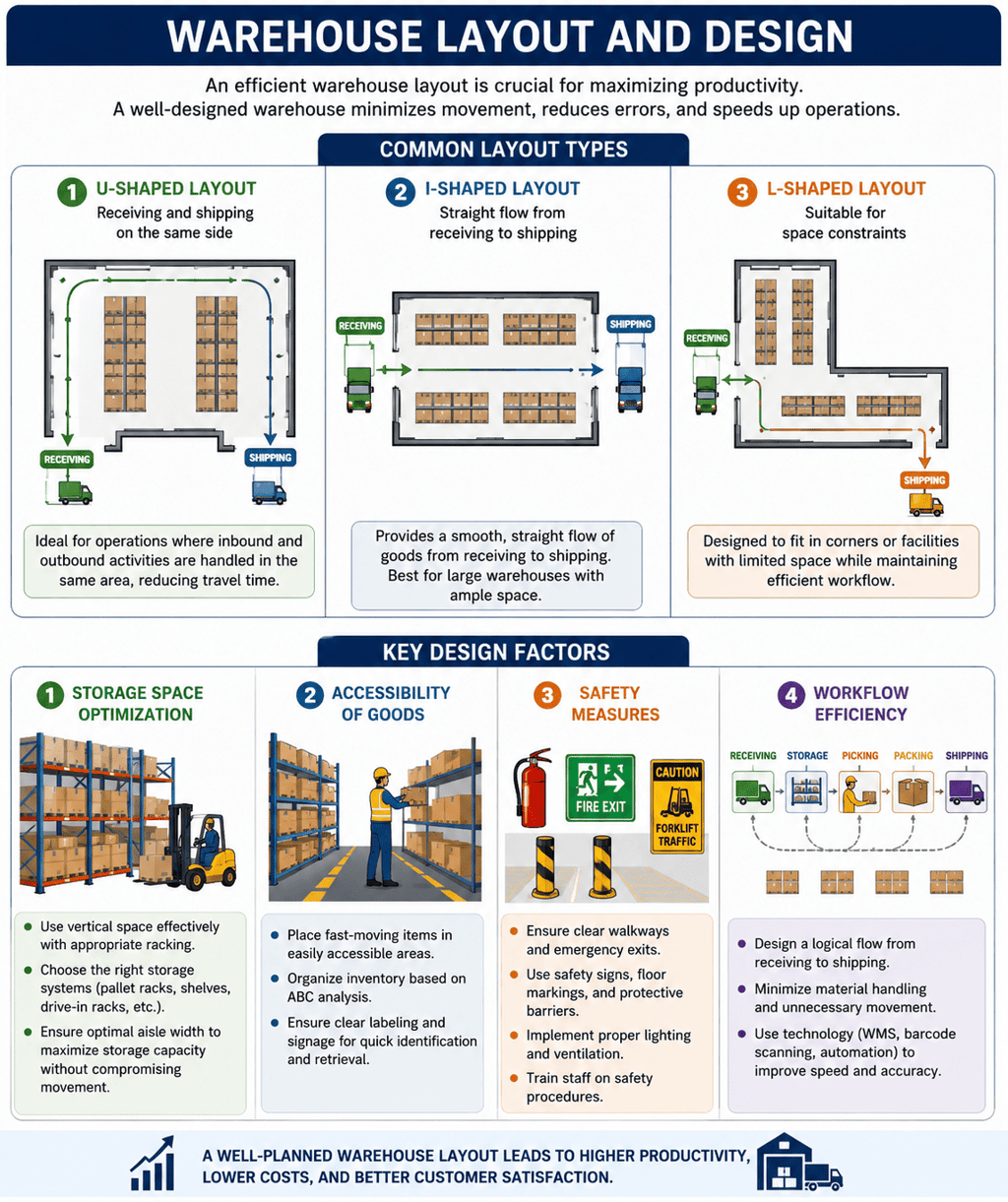
Warehouse Layout and Design
An efficient warehouse layout is crucial for maximizing productivity. A well-designed warehouse minimizes movement, reduces errors, and speeds up operations.
Common Layout Types:
U-shaped layout – Receiving and shipping on the same side
I-shaped layout – Straight flow from receiving to shipping
L-shaped layout – Suitable for space constraints
Key Design Factors:
Storage space optimization
Accessibility of goods
Safety measures
Workflow efficiency
Challenges in Warehousing
Despite its importance, warehousing comes with several challenges:
1. Inventory Inaccuracy
Mismatch between physical and recorded stock can lead to delays and losses.
2. Space Utilization Issues
Poor layout planning can result in wasted space.
3. Labor Management
Managing workforce efficiency and productivity is a constant challenge.
4. High Operational Costs
Rent, labor, and technology investments can increase expenses.
5. Demand Uncertainty
Fluctuating demand makes inventory planning difficult.
How to Improve Warehouse Efficiency?
Improving warehouse performance is key to staying competitive. Here are some proven strategies:
Implement a Warehouse Management System (WMS)
Use automation and robotics for repetitive tasks
Optimize warehouse layout
Train employees regularly
Use data analytics for decision-making
Adopt barcode or RFID systems
Let's take Amazon as an example.,
Amazon uses advanced WMS software to monitor millions of products across its fulfillment centers. The system automatically assigns storage locations, tracks inventory movement, and optimizes picking routes, ensuring faster and more accurate order processing.
In Amazon warehouses, robots (like Kiva robots) move shelves of products directly to workers instead of workers walking long distances. This significantly reduces picking time and increases productivity while minimizing human fatigue.
They design their fulfillment centers with highly optimized layouts where fast-moving items are placed closer to packing and shipping areas. This reduces travel time and speeds up order fulfillment.
They continuously trains its warehouse staff on new technologies, safety protocols, and efficient picking methods. Employees are guided by handheld devices that show optimized picking paths, reducing errors and improving speed.
Amazon uses predictive analytics to forecast demand and position inventory closer to customers. This ensures faster deliveries and reduces storage and transportation costs.
Every product in an Amazon warehouse is scanned using barcode systems at each stage—from receiving to delivery. This ensures real-time tracking, reduces errors, and improves order accuracy.
What makes Amazon highly efficient is not just one strategy—but the combination of technology, optimized processes, and trained workforce working together. That’s the real takeaway for improving any warehouse operation.
Role of Technology in Modern Warehousing
Technology is transforming warehousing into a smart and connected ecosystem.
Key Technologies:
Automation & Robotics – Speeds up picking and packing
Artificial Intelligence (AI) – Predicts demand and optimizes inventory
Internet of Things (IoT) – Enables real-time tracking
RFID & Barcodes – Improves accuracy and visibility
These technologies not only enhance efficiency but also reduce operational costs.
Conclusion
Warehousing is a vital component of supply chain management that goes far beyond simple storage. It ensures efficient inventory management, faster order fulfillment, and improved customer satisfaction.
As businesses continue to expand and customer expectations rise, the role of warehousing will only become more critical. By adopting modern technologies, optimizing operations, and focusing on efficiency, companies can turn their warehouses into powerful competitive advantages.