From Factory to Your Door: What Is Supply Chain Management? (2026 Guide)
Supply Chain Management (SCM) explained simply—learn how products move from factories to your door, why delays happen, and how businesses optimize delivery and costs.
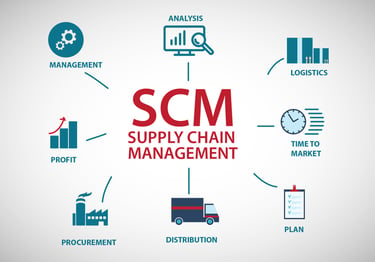
What Is Supply Chain Management?
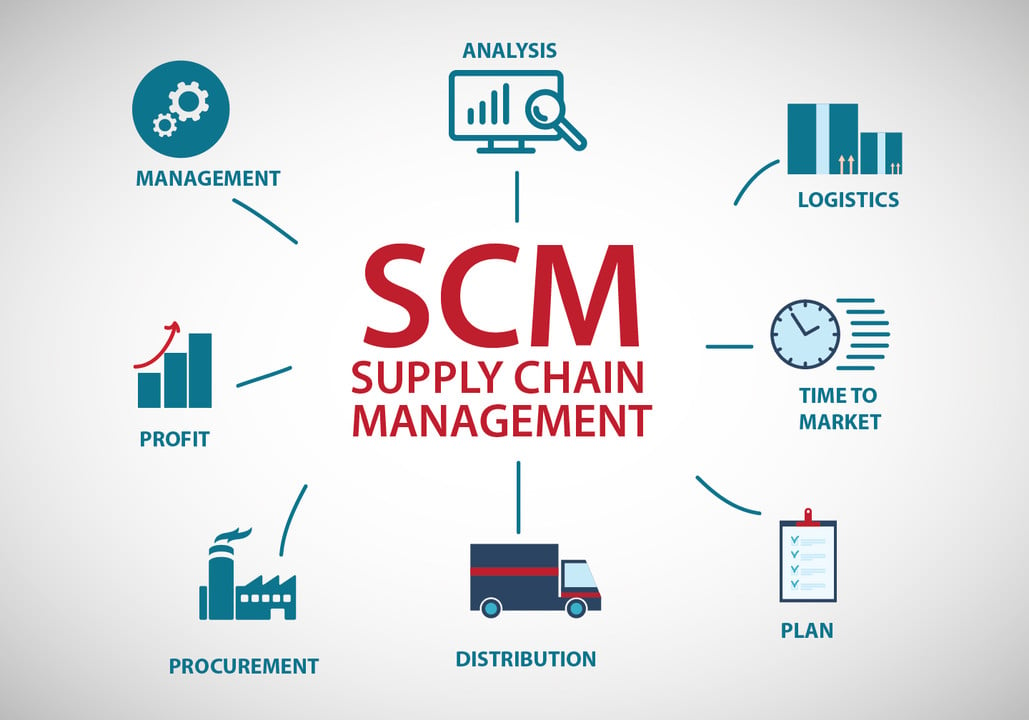
Supply Chain Management (SCM) is the end-to-end coordination of all activities involved in producing, moving, storing, and delivering a product from the supplier to the final customer.
It involves:
Procurement (buying raw materials)
Manufacturing (making the product)
Warehousing (storing it safely)
Logistics (transportation & delivery)
Customer Service
Reverse Logistics (returns & replacements)
Simple Definition:
SCM ensures the right product reaches the right customer, in the right quantity, at the right time, and at the lowest possible cost.
Real-Life Example: The Supply Chain of a T-Shirt
Let’s understand SCM through an example:
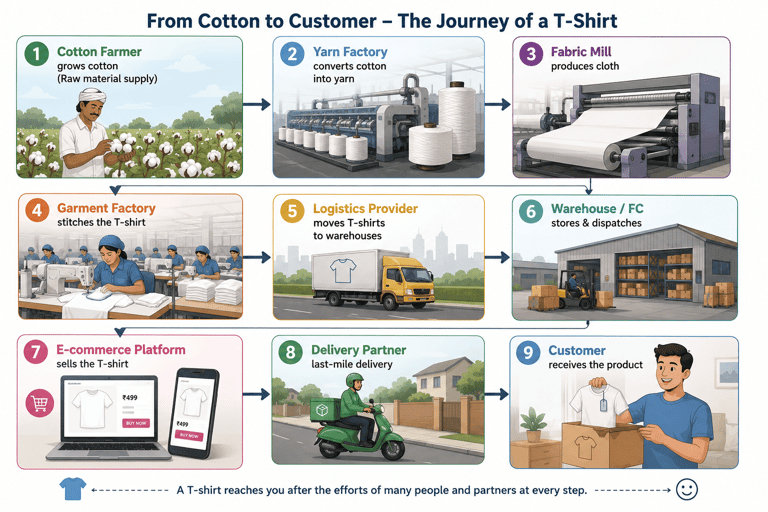
Cotton Farmer – grows cotton (Raw material supply)
Yarn Factory – converts cotton into yarn
Fabric Mill – produces cloth
Garment Factory – stitches the T-shirt
Logistics Provider – moves T-shirts to warehouses
Warehouse/FC – stores & dispatches
E-commerce Platform – sells the T-shirt
Delivery Partner – last-mile delivery
Customer – receives the product
💡 SCM ensures all 9 stages work smoothly without delays. Here's the story of a T-shirt, told in pictures.
Why Supply Chain Management Is Important
1. Cost Reduction
Cost reduction in supply chain management focuses on minimizing operational expenses while maintaining efficiency and product quality. Businesses achieve this by optimizing transportation routes, consolidating shipments, reducing unnecessary handling costs, process efficiency and Inventory optimization. Strategic sourcing and strong supplier relationships also play a key role in negotiating better pricing for raw materials and services. A well-structured supply chain reduces overall expenses, improves profit margins, and strengthens competitiveness in the market. Companies that continuously analyze and refine their supply chain processes are better positioned to sustain long-term cost efficiency.
2. Faster Delivery
Faster delivery is a key competitive advantage in modern supply chain management, especially with the growth of e-commerce and customer expectations for quick service. It involves reducing lead times across every stage of the supply chain, from procurement to final delivery. Efficient logistics planning, warehouse efficiency, reliable transportation partners are the vital components of a successful supply chain strategy.
3. Higher Customer Satisfaction
Customer satisfaction is directly influenced by how well a supply chain performs. Timely delivery, product availability, and consistent quality are all essential factors that shape the customer experience. A well-managed supply chain ensures that customers receive the right product at the right time without delays or errors. Businesses that prioritize customer-focused supply chain strategies are more likely to build loyalty, gain repeat customers, and strengthen their brand image in a competitive market.
4. Better Inventory Planning
Better inventory planning ensures that businesses maintain the right balance between supply and demand. It helps prevent both overstocking and stockouts, which can negatively impact profitability and customer satisfaction. Smart inventory planning uses 8 key techniques that simultaneously minimize costs and maximize operational performance. Businesses that invest in strong inventory strategies can respond quickly to market changes and maintain a competitive edge.
5. Business Continuity
Business continuity in supply chain management refers to the ability of a company to maintain operations during disruptions such as natural disasters, supplier failures, or transportation delays. A resilient supply chain ensures minimal impact on business performance even in uncertain situations. A robust business continuity strategy not only protects operations but also builds customer trust and long-term sustainability, making it an essential part of modern supply chain management.
Core Components of Supply Chain Management
A. Procurement
Sourcing raw materials
Selecting suppliers
Negotiating prices
Ensuring quality
B. Manufacturing
Production planning
Assembly
Quality control
Packaging
C. Logistics
Transportation
Distribution
Route planning
Freight optimization
D. Warehousing
Receiving (Inbound)
Put away
Storage
Picking
Packing
Dispatch
Returns
E. Inventory Management
Stock classification (ABC analysis)
Safety stock
Reorder levels
Stock accuracy
F. Information Flow
SCM depends heavily on ERP systems, WMS, TMS, and data visibility.
How Does a Supply Chain Actually Work? (Step-by-Step)
The journey of a T-shirt from a cotton farm to the final customer is a classic example to understand the step by step process of how supply chain works. It involves multiple stages, each adding value and ensuring the product reaches the consumer efficiently. Understanding this process helps businesses improve logistics, reduce costs, and enhance customer satisfaction.
Raw Material Stage – Cotton Farmer
The supply chain begins with cotton farmers who grow and harvest raw cotton. This stage is critical as the quality of cotton directly impacts the final product. Proper farming techniques, weather conditions, and harvesting methods determine fiber quality, which influences durability and comfort of the T-shirt.
Processing Stage – Yarn and Fabric Production
Once harvested, cotton is sent to a yarn factory where it is cleaned, spun, and converted into yarn. The yarn then moves to a fabric mill, where it is woven or knitted into cloth. These processes transform raw material into usable fabric, adding significant value at each step.
Manufacturing Stage – Garment Factory
The fabric is then transported to garment factories where it is cut, stitched, and finished into T-shirts. Quality checks are conducted to ensure consistency in size, design, and durability. This stage plays a major role in defining the final product’s appearance and quality.
Distribution Stage – Logistics and Warehousing
After manufacturing, logistics providers transport the finished T-shirts to warehouses or fulfillment centers. Here, products are stored, sorted, and prepared for order fulfillment. Efficient warehousing ensures quick dispatch and reduces delivery delays.
Sales Stage – E-commerce Platform
E-commerce platforms list the T-shirts online, making them accessible to customers. These platforms manage product visibility, pricing, and order processing. Digital presence plays a key role in reaching a wider audience and driving sales.
Final Delivery – Last-Mile and Customer
Once an order is placed, delivery partners handle last-mile delivery to the customer’s doorstep. This is the final and most visible stage of the supply chain. Timely and accurate delivery directly impacts customer satisfaction and brand perception.
Key Metrics in Supply Chain Management
Here are the most used KPIs:
1. OTIF (On-Time In-Full)
OTIF, or On-Time In-Full, is a critical supply chain performance metric that measures whether orders are delivered to customers on time and in the correct quantity. It reflects the efficiency and reliability of the entire supply chain, from order processing to final delivery. A high OTIF score indicates strong coordination between inventory, warehousing, and logistics operations. Businesses use OTIF to track service levels, reduce delivery delays, and improve customer satisfaction. Maintaining a high OTIF rate helps build trust with customers and ensures consistent order fulfillment performance.
2. Lead Time
Lead time refers to the total time taken from placing an order to receiving the final product. It includes processing, production, and transportation time. In supply chain management, reducing lead time is essential for improving responsiveness and meeting customer expectations. Shorter lead times enable faster delivery, better inventory control, and improved operational efficiency. Businesses that optimize lead time can respond quickly to market demand and gain a competitive advantage in fast-moving industries.
3. Inventory Turnover
Inventory turnover is a key metric that measures how often a company sells and replaces its inventory over a specific period. It indicates how efficiently inventory is managed and how quickly products move through the supply chain. A higher inventory turnover ratio suggests strong sales and effective inventory planning, while a lower ratio may indicate overstocking or slow-moving goods. Monitoring inventory turnover helps businesses reduce holding costs, improve cash flow, and maintain optimal stock levels.
4. Fill Rate
Fill rate measures the percentage of customer demand that is fulfilled from available inventory without delays or backorders. It reflects how effectively a company can meet customer orders from its existing stock. A high fill rate indicates efficient inventory management and strong product availability. Businesses track fill rate to improve service levels, minimize stockouts, and enhance customer satisfaction. It is an important indicator of supply chain performance and demand planning accuracy.
5. Picking Accuracy
Picking accuracy refers to the correctness of items selected from a warehouse to fulfill customer orders. It measures how often the right products, quantities, and specifications are picked without errors. High picking accuracy is essential for reducing returns, avoiding customer complaints, and maintaining operational efficiency. Warehouses use technologies like barcode scanning and automation to improve picking accuracy. Consistently accurate order picking leads to better customer experience and lower operational costs.
6. Cost per Shipment
Cost per shipment is a logistics metric that calculates the average cost incurred to deliver a single order. It includes transportation, packaging, handling, and operational expenses. Monitoring cost per shipment helps businesses identify inefficiencies and optimize their logistics processes. Reducing this cost without compromising delivery quality is key to improving profitability. Companies use this metric to make better decisions regarding shipping methods, carrier selection, and route optimization.
Careers in Supply Chain (2026 Opportunities)
The supply chain job market is booming in India and globally.
Popular roles:
Warehouse Executive
Logistics Coordinator
Supply Planner
Inventory Controller
Procurement Analyst
Order Management Specialist
Supply Chain Analyst
Supply chain professionals are becoming essential in e-commerce, retail, pharmaceuticals, manufacturing, and FMCG.
8. Future Trends in Supply Chain (2026 and Beyond)
🔹 AI & Automation
Predictive planning, automated picking, smart routing.
🔹 Robotics
Robotic arms, conveyors, AMRs in warehouses.
🔹 Internet of Things (IoT)
Real-time tracking of goods.
🔹 Blockchain
Transparent supplier management.
🔹 Sustainability
Eco-friendly packaging & carbon-neutral transport.
Final Thoughts
Supply Chain Management is not just about moving goods—it's about ensuring businesses operate smoothly, efficiently, and customer expectations are met every single day.
For anyone looking to grow in operations, logistics, or warehousing, understanding SCM is the first and most important step.