
What is OTIF (On-Time In-Full)? Formula, Example & Importance (2026 Guide)
Learn what OTIF (On-Time In-Full) means, how to calculate it, with examples and benefits. Improve delivery performance, reduce delays, and boost customer satisfaction.
📦 What is OTIF (On-Time In-Full)?
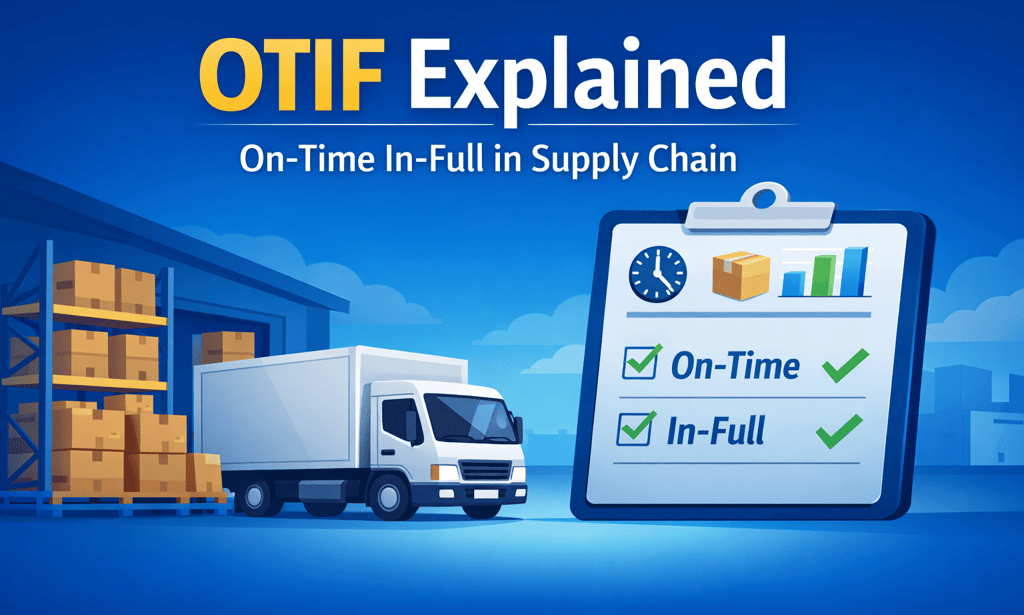
OTIF (On-Time In-Full) is a supply chain performance metric that measures whether customer orders are delivered:
On-Time → Delivered on or before the agreed delivery date
In-Full → Delivered with the complete quantity ordered (no shortages)
In simple terms, OTIF answers this question:
Did the customer receive the right products, in the right quantity, at the right time?
If the answer is yes, the order is considered OTIF compliant.
🎯 Why is OTIF Important?
OTIF is not just a metric—it directly impacts overall business performance, operational efficiency, and long-term customer relationships. Companies that consistently meet OTIF targets build trust, reduce costs, and gain a strong position in the market.
1. Customer Satisfaction
Customers today expect fast, accurate, and reliable deliveries. Even a single delayed or incomplete order can create frustration and reduce trust. Consistently high OTIF ensures customers receive exactly what they ordered, on time, which leads to repeat business, positive reviews, and stronger brand loyalty.
2. Retail Compliance
Large retailers and marketplaces often set strict OTIF benchmarks (typically 95% or higher). Failing to meet these standards can result in penalties, chargebacks, or even loss of supplier contracts. Maintaining high OTIF is essential for businesses that want to build and sustain relationships with major retailers.
3. Operational Efficiency
Tracking OTIF helps businesses identify bottlenecks and inefficiencies across the supply chain. It provides valuable insights into areas such as:
Warehousing
Inventory management
Transportation planning
By analyzing OTIF performance, companies can streamline processes, reduce delays, and improve overall supply chain coordination.
4. Competitive Advantage
In a competitive market, reliability is a key differentiator. Companies with high OTIF scores are seen as dependable and professional partners. This not only helps in retaining existing customers but also attracts new business opportunities and strengthens partnerships across the supply chain.
Improving OTIF is not just about meeting targets—it’s about building a more efficient, reliable, and customer-focused business.
📊 OTIF Formula
The OTIF metric is typically calculated as a percentage:
OTIF (%) = (Number of Orders Delivered On-Time and In-Full ÷ Total Orders) × 100
🧮 OTIF Example
Let’s understand this with a simple example:
Total orders shipped in a month = 100
Orders delivered on time = 90
Orders delivered in full = 85
Orders delivered both on-time and in-full = 80
Now apply the formula:
OTIF = (80 ÷ 100) × 100 = 80%
✅ Interpretation:
An OTIF score of 80% means:
80 out of 100 orders met both delivery conditions
20 orders failed either in timing, quantity, or both
⚠️ Common Reasons for Low OTIF
Many businesses struggle to achieve high OTIF scores due to issues across the supply chain. Some common causes include:
1. Poor Inventory Management
Stockouts or inaccurate inventory records lead to incomplete deliveries.
2. Inefficient Warehouse Operations
Picking errors, delays in packing, or dispatch issues can affect both timing and quantity.
3. Transportation Delays
Traffic, route inefficiencies, or carrier issues can cause late deliveries.
4. Demand Forecasting Errors
Incorrect demand planning results in either excess stock or shortages.
5. Lack of Real-Time Visibility
Without proper tracking systems, it becomes difficult to monitor order status and take corrective action.
📈 How to Improve OTIF Performance
Improving OTIF requires a combination of process optimization, technology, and better planning.
1. Improve Demand Forecasting
Use historical data and analytics to predict demand more accurately and avoid stock shortages.
2. Optimize Inventory Management
Maintain safety stock levels
Use inventory management systems
Regularly audit stock accuracy
3. Enhance Warehouse Efficiency
Implement Warehouse Management Systems (WMS)
Use barcode scanning to reduce errors
Optimize picking and packing processes
4. Optimize Transportation Planning
Use route optimization tools
Partner with reliable logistics providers
Monitor delivery performance regularly
5. Use Real-Time Tracking
Implement systems that provide real-time visibility into shipments, enabling faster decision-making.
🏆 What is a Good OTIF Score?
A “good” OTIF score depends on the industry, but general benchmarks are:
Below 85% → Needs improvement
85% – 95% → Acceptable performance
95%+ → Excellent performance
Top-performing companies aim for 98% or higher.
🔍 OTIF vs Other Supply Chain Metrics
OTIF is often used alongside other key metrics:
Fill Rate → Measures how much of the order demand is fulfilled
On-Time Delivery (OTD) → Focuses only on delivery timing
Perfect Order Rate → Includes additional factors like damage-free delivery and correct documentation
While these metrics provide insights into specific areas, OTIF gives a combined view of delivery performance.
🚀 Final Thoughts
OTIF (On-Time In-Full) is one of the most critical KPIs in supply chain management. It reflects how well a company can meet customer expectations in terms of both delivery timing and order accuracy.
For businesses looking to improve customer satisfaction, reduce penalties, and build a strong reputation, focusing on OTIF is essential. By improving inventory management, optimizing logistics, and leveraging technology, companies can significantly enhance their OTIF performance.
📌 Key Takeaways
OTIF measures delivery performance based on time and completeness
It is crucial for customer satisfaction and operational efficiency
The formula is simple, but improving it requires strong supply chain coordination
A score above 95% is considered excellent
If you consistently monitor and improve your OTIF score, you’ll not only streamline your operations but also build long-term trust with your customers.