What is FIFO in Inventory Management? Method, Examples & Benefits
Learn what FIFO is in inventory management with simple examples, benefits, and how it works. Improve stock control, reduce waste, boost efficiency, and enhance inventory accuracy
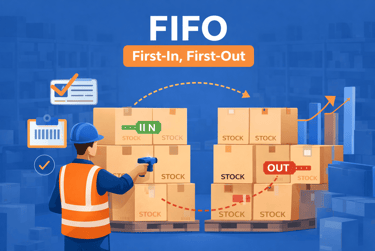
🔷 What is FIFO?
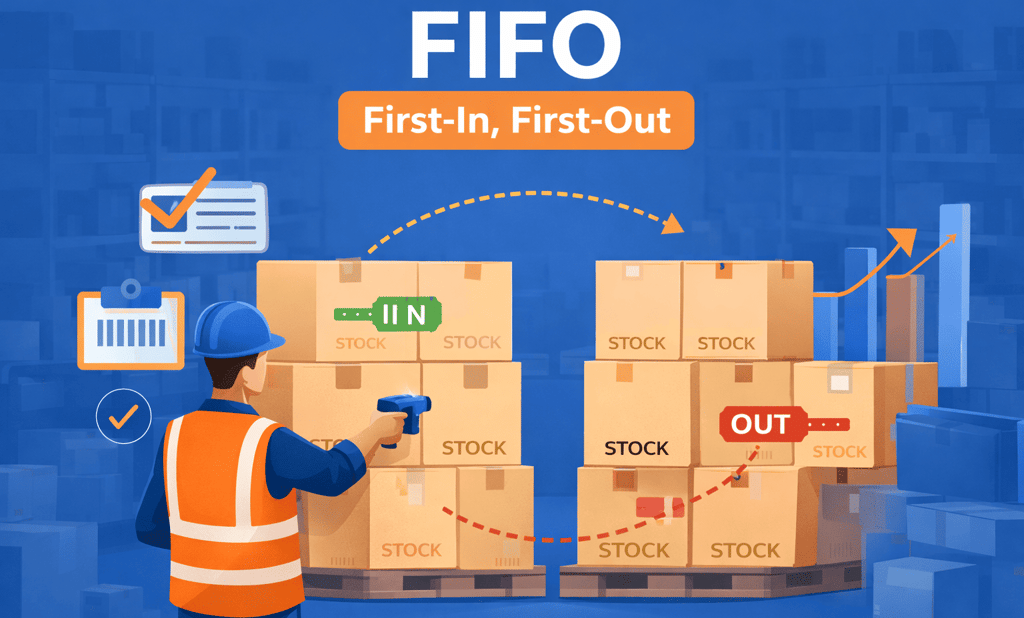
FIFO (First-In, First-Out) is an inventory management method where the first items purchased or produced are the first ones to be sold or used.
In simple terms, older stock is cleared before newer stock. This method aligns closely with the natural flow of goods in many industries, especially those dealing with food, pharmaceuticals, and retail products.
🔷 Why is FIFO Important?
FIFO plays a crucial role in maintaining an efficient and accurate inventory system.
Key benefits include:
Reduces risk of spoilage or obsolescence
Ensures better stock rotation
Improves inventory accuracy
Reflects realistic cost flow
Helps maintain product quality
For businesses handling perishable goods, FIFO is not just an option—it’s a necessity.
🔷 How FIFO Works
FIFO follows a straightforward principle:
👉 The oldest inventory is sold first, regardless of current purchase price.
Example:
A company purchases:
100 units at ₹50 (January)
100 units at ₹60 (February)
If the company sells 120 units:
First 100 units → ₹50 (January stock)
Next 20 units → ₹60 (February stock)
This ensures that older inventory is always cleared first.
🔷 FIFO in Inventory Valuation
FIFO is also widely used in accounting to calculate the cost of goods sold (COGS) and ending inventory.
Under FIFO:
Older (cheaper) inventory is recorded as sold first
Remaining inventory reflects recent (higher) costs
This often results in:
Lower COGS
Higher profits (during inflation)
🔷 Real-World Example
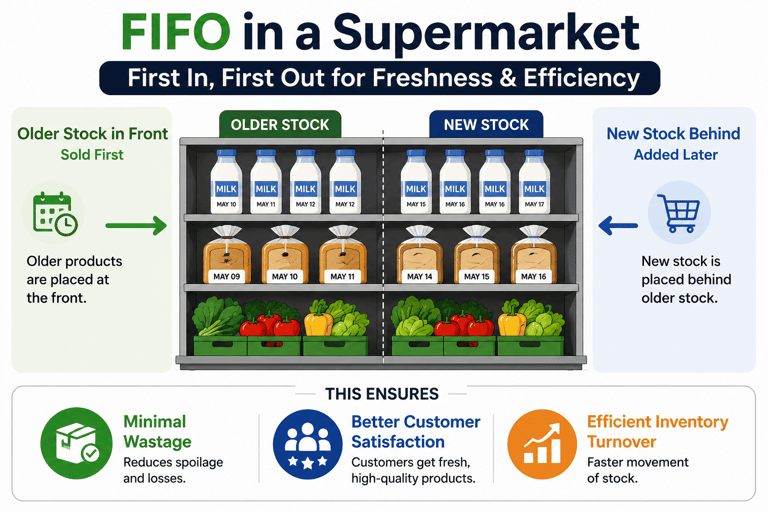
Consider a supermarket:
Products like milk, bread, and vegetables have short shelf lives. If newer stock is sold before older stock, the older items may expire and lead to losses.
Using FIFO:
Older products are placed at the front
New stock is placed behind
This ensures:
Minimal wastage
Better customer satisfaction
Efficient inventory turnover
Large companies like Amazon and Walmart also use FIFO principles in their warehouse operations to manage massive inventories effectively.
🔷 Advantages of FIFO
✅ 1. Reduces Waste
FIFO ensures older inventory is used first, minimizing spoilage.
✅ 2. Easy to Understand & Implement
The method follows a natural flow, making it simple for businesses to adopt.
✅ 3. Improves Inventory Accuracy
Stock records remain aligned with actual physical inventory.
✅ 4. Better Financial Reporting
Ending inventory reflects current market prices, improving balance sheet accuracy.
✅ 5. Ideal for Perishable Goods
Perfect for industries like food, pharmaceuticals, and cosmetics.
🔷 Disadvantages of FIFO
While FIFO has many benefits, it also has some limitations:
❌ 1. Higher Tax Liability
During inflation, FIFO shows higher profits, leading to higher taxes.
❌ 2. Not Suitable for All Industries
Industries with non-perishable or interchangeable goods may not benefit as much.
❌ 3. Price Fluctuation Impact
Does not always reflect current market costs in cost of goods sold.
🔷 Best Practices for Implementing FIFO
To use FIFO effectively, businesses should go beyond basic rotation and build a system that supports accuracy, consistency, and scalability
🔹 Proper Warehouse Layout
Design your warehouse so that older inventory is always the easiest to access. Use flow-based layouts like first-in, first-out lanes or gravity racks where stock naturally moves forward. Keep receiving and dispatch areas clearly separated to avoid mix-ups. A well-planned layout reduces handling time, minimizes errors, and ensures older stock doesn’t get buried under new arrivals.
🔹 Use Inventory Management Software like WMS , JDA or anything
Manual tracking quickly becomes unreliable as your business grows. Implement a Warehouse Management System (WMS) such as solutions from Blue Yonder or other modern tools. These systems automate stock tracking, provide real-time inventory visibility, and help enforce FIFO rules through alerts and batch tracking. This improves accuracy and reduces costly mistakes.
🔹 Labeling & Tracking
Every product batch should be clearly labeled with key details like date of receipt, batch number, and expiry date (if applicable). Use barcodes or RFID systems to make tracking faster and more reliable. Proper labeling ensures that warehouse staff can easily identify which items need to be picked first, preventing confusion and delays.
🔹 Regular Audits
Conduct routine inventory audits such as cycle counts or full stock checks. This helps identify discrepancies early and ensures that your FIFO system is being followed correctly. Regular audits also improve accountability and keep your inventory data aligned with actual stock levels.
🔹 Staff Training
Even the best systems fail without proper execution. Train your team on FIFO principles, warehouse processes, and the importance of stock rotation. When employees understand why FIFO matters—reducing waste, improving quality, and maintaining compliance—they’re more likely to follow it consistently.
🔷 Common Challenges in FIFO
Even though FIFO is simple, businesses may face challenges:
Poor warehouse organization
Lack of tracking systems
Human errors in stock handling
High implementation effort in large operations
Proper planning and tools can help overcome these issues.
🔷 Conclusion
FIFO is one of the most effective and widely used inventory management techniques in modern supply chains. By ensuring that older stock is used first, it helps businesses reduce waste, improve efficiency, and maintain product quality.
Whether you are managing a small warehouse or a large-scale logistics operation, implementing FIFO can significantly enhance your inventory control and overall supply chain performance.