

Hybrid Sourcing Strategy in Supply Chain: Benefits, Examples & Implementation Guide (2026)
Learn how a hybrid sourcing strategy combines global cost savings with local flexibility. Explore benefits, real examples, and step-by-step implementation in this 2026 guide.
Supply Chain Navigator
6/13/20267 min read
In today’s volatile supply chain environment, relying on a single sourcing approach is no longer enough. Businesses must balance cost, speed, and risk—without compromising efficiency.
That’s where a hybrid sourcing strategy becomes critical - especially when compared to different sourcing approaches like global vs local sourcing.
What is Hybrid Sourcing Strategy?
A hybrid sourcing strategy is a procurement approach where businesses use both global and local suppliers to optimize cost, reduce supply chain risk, and improve flexibility. It combines low-cost international sourcing with fast, reliable local sourcing to create a balanced and resilient supply chain.
Hybrid Sourcing vs Global vs Local Sourcing (Quick Comparison)
👉 Want a deeper comparison? Read our guide on global vs local sourcing strategy.
Why Hybrid Sourcing Strategy is Gaining Popularity
Recent global disruptions - from pandemics to geopolitical conflicts - have exposed the risks of relying solely on global sourcing. At the same time, local sourcing alone often leads to higher costs and limited scalability.
Hybrid sourcing solves both problems by combining:
Cost efficiency of global suppliers
Speed and reliability of local suppliers
Flexibility to adapt to demand changes
Key Drivers of Hybrid Sourcing Adoption
Increased supply chain disruptions
Rising freight and logistics costs
Demand for faster delivery
Need for risk diversification
Sustainability and carbon reduction goals
Hybrid sourcing is no longer a trend - it’s becoming a necessity.
Key Benefits of Hybrid Sourcing Strategy
1. Cost Optimization
One of the biggest advantages of hybrid sourcing is the ability to balance cost and efficiency.
Global sourcing reduces production costs
Local sourcing reduces logistics and inventory costs
This creates a more accurate total cost advantage, not just lower unit pricing.
2. Reduced Supply Chain Risk
Relying on a single region can be risky. Hybrid sourcing spreads risk across multiple suppliers and geographies.
This helps protect against:
Political instability
Trade restrictions
Natural disasters
Port congestion
By diversifying sourcing, businesses become more resilient.
3. Faster Lead Times
Local suppliers enable quicker response to demand changes.
With hybrid sourcing:
Global suppliers handle bulk production
Local suppliers handle urgent or variable demand
This significantly improves responsiveness.
4. Improved Flexibility
Demand is rarely stable. Hybrid sourcing allows businesses to adjust quickly.
For example:
Use global suppliers for predictable demand
Use local suppliers for fluctuations
This flexibility is critical in industries like retail and electronics.
5. Better Customer Satisfaction
Faster delivery and product availability lead to better customer experiences.
Hybrid sourcing enables:
Reduced stockouts
Faster order fulfillment
Improved service levels
6. Sustainability Benefits
Shorter supply chains reduce transportation emissions.
By combining local sourcing with global sourcing, companies can:
Reduce carbon footprint
Support local economies
Meet sustainability goals
Challenges of Hybrid Sourcing Strategy
While hybrid sourcing offers many benefits, it also introduces complexities that businesses must carefully manage. Understanding these challenges is essential to ensure the strategy delivers its intended value.
1. Increased Complexity
Managing multiple suppliers across different regions is far more complex than relying on a single source. Companies must coordinate production schedules, align quality standards, and manage logistics across diverse geographies. Miscommunication or poor coordination can lead to delays, inefficiencies, and higher costs. Supplier communication and logistics management become critical areas requiring strong oversight.
2. Higher Management Effort
With more suppliers comes more contracts, negotiations, and ongoing monitoring. Businesses must invest in supplier management systems, advanced procurement tools, and skilled teams capable of handling the added workload. Without these resources, the administrative burden can outweigh the benefits of hybrid sourcing, leading to inefficiencies and missed opportunities.
3. Cost Balancing Difficulties
Balancing global cost savings with local efficiency is not straightforward. While global sourcing may reduce unit costs, hidden expenses such as tariffs, shipping, and inventory holding can erode savings. Similarly, local sourcing may improve responsiveness but at higher production costs. Without careful analysis and planning, businesses risk increasing overall expenses instead of achieving a true cost advantage.
4. Supply Chain Coordination
Synchronizing global and local supply chains is one of the toughest challenges. Delays in global shipments can disrupt local production schedules, while poor planning may lead to excess inventory or stockouts. Effective coordination requires advanced forecasting, integrated systems, and strong collaboration between global and local teams. Without this, hybrid sourcing can create bottlenecks rather than efficiencies.
Hybrid Sourcing vs Dual Sourcing (Important Difference)
Many people confuse hybrid sourcing with dual sourcing—but they are different.
Dual sourcing: Using two suppliers for the same product
Hybrid sourcing: Using both global and local suppliers strategically
Hybrid sourcing focuses on balancing cost, speed, and risk, not just supplier backup.
How to Implement a Hybrid Sourcing Strategy (Step-by-Step)
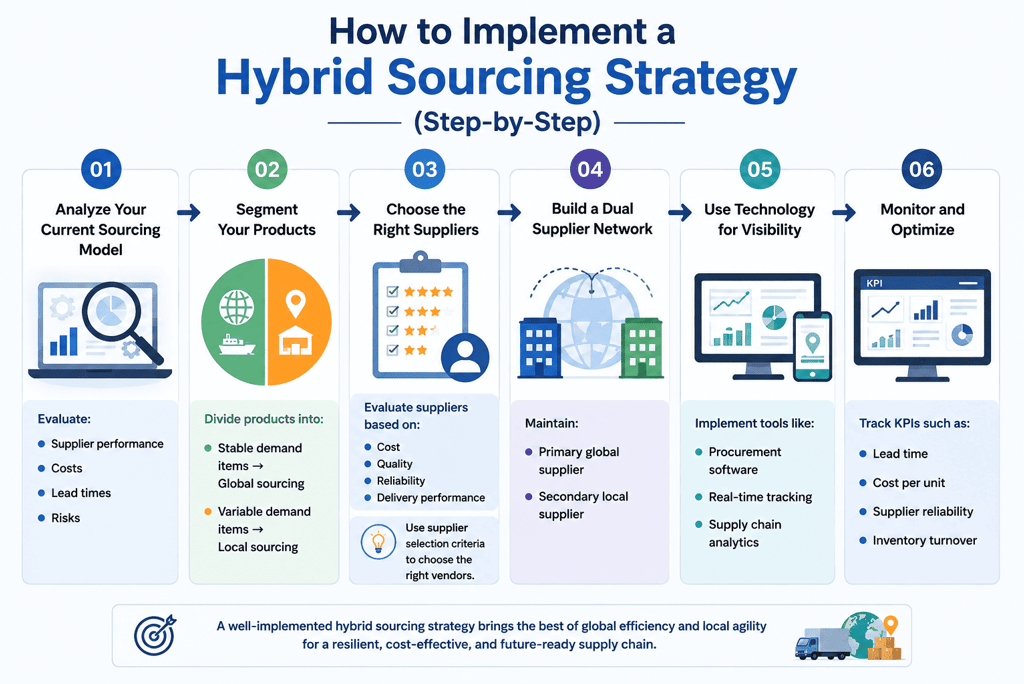
Step 1: Analyze Your Current Sourcing Model
Evaluate:
Supplier performance
Costs
Lead times
Risks
Step 2: Segment Your Products
Divide products into:
Stable demand items → Global sourcing
Variable demand items → Local sourcing
Step 3: Choose the Right Suppliers
Evaluate suppliers based on:
Cost
Quality
Reliability
Delivery performance
👉 Use supplier selection criteria to choose the right vendors.
Step 4: Build a Dual Supplier Network
Maintain:
Primary global supplier
Secondary local supplier
Step 5: Use Technology for Visibility
Implement tools like:
Procurement software
Real-time tracking
Supply chain analytics
Step 6: Monitor and Optimize
Track KPIs such as:
Lead time
Cost per unit
Supplier reliability
Inventory turnover
You can track these using procurement KPIs and performance metrics.
Real-World Examples of Hybrid Sourcing
Theory is useful, but hybrid sourcing really comes alive when you see how industries apply it in practice. Here are three sectors where the model is widely used:
1. Automotive Industry
Car manufacturers are classic adopters of hybrid sourcing. They often source complex components like engines, electronics, or transmissions from global suppliers who specialize in high‑volume production. At the same time, final assembly is carried out locally to meet regional demand quickly and comply with local regulations. This approach reduces costs while ensuring vehicles are tailored to market needs and delivered faster.
2. Electronics Industry
Electronics companies rely on a global network of suppliers for critical components such as semiconductors, circuit boards, and batteries. However, they frequently assemble products closer to key markets to improve speed and reduce shipping delays. For example, smartphones may be produced with parts sourced from multiple countries but assembled regionally to shorten lead times. This hybrid model balances cost efficiency with responsiveness in a fast‑moving industry.
3. Retail Industry
Retail brands face the challenge of managing seasonal demand and unpredictable consumer trends. Hybrid sourcing helps them strike the right balance. Bulk production of staple items is often done overseas to keep costs low, while fast‑moving or trend‑driven products are sourced locally to respond quickly to shifts in demand. This ensures inventory levels are maintained without overstocking, while still keeping shelves stocked with what customers want most.
Key Factors to Consider Before Choosing Hybrid Sourcing
Hybrid sourcing is not a one‑size‑fits‑all solution. Before adopting this strategy, businesses must carefully evaluate several critical factors to ensure it aligns with their operational goals and market realities.
1. Total Cost of Ownership
Looking beyond unit price is essential. The true cost of sourcing includes production expenses, logistics, duties, and inventory holding costs. Global suppliers may offer lower production costs, but shipping, tariffs, and longer lead times can add hidden expenses. Local suppliers may reduce logistics and inventory costs, but at higher production rates. A comprehensive view of total cost of ownership helps businesses avoid misleading savings and make smarter sourcing decisions.
2. Demand Variability
Hybrid sourcing works best in industries where demand fluctuates. By combining global suppliers for stable, predictable demand with local suppliers for urgent or variable needs, businesses can respond quickly to market changes. This flexibility ensures they don’t overcommit resources during slow periods or fall short when demand spikes unexpectedly.
3. Risk Tolerance
Every business has a different appetite for risk. Companies with low risk tolerance benefit most from hybrid sourcing because it diversifies supply across regions and suppliers. This reduces exposure to disruptions such as political instability, trade restrictions, or natural disasters. For organizations willing to accept higher risk in exchange for lower costs, a hybrid model still provides a safety net by balancing global and local sources.
4. Supplier Availability
Hybrid sourcing requires reliable supplier options both globally and locally. Businesses must ensure that qualified partners exist in each region to support their strategy. Without strong supplier availability, the model can break down—leading to delays, quality issues, or cost overruns. Evaluating supplier networks upfront is critical to building a resilient hybrid sourcing framework.
Future Trends in Hybrid Sourcing
Hybrid sourcing is evolving rapidly as businesses adapt to shifting market dynamics, technological innovation, and growing sustainability pressures. Several emerging trends are shaping how companies will design and manage their supply chains in the years ahead.
1. Nearshoring Growth
Companies are increasingly moving production closer to their key markets. Nearshoring reduces transportation costs, shortens lead times, and minimizes exposure to global disruptions such as port congestion or geopolitical tensions. For example, U.S. firms are turning to Mexico as a nearshoring hub, while European businesses look to Eastern Europe. This trend strengthens responsiveness and aligns supply chains more closely with customer demand.
2. Digital Procurement
Technology is transforming procurement into a strategic powerhouse. Artificial intelligence, predictive analytics, and blockchain are improving sourcing decisions by providing real‑time visibility into supplier performance, pricing, and risk factors. Digital procurement platforms allow businesses to optimize supplier selection, automate routine tasks, and enhance transparency. As these tools mature, procurement will shift from transactional buying to a central driver of innovation and collaboration.
3. Supply Chain Diversification
The risks of over‑reliance on a single region have become clear in recent years. Hybrid sourcing strategies are increasingly focused on expanding supplier networks across multiple geographies. By diversifying, businesses reduce vulnerability to trade restrictions, natural disasters, or political instability. This approach creates a more resilient supply chain capable of withstanding shocks while maintaining continuity of supply.
4. Sustainable Sourcing
Environmental considerations are becoming a priority in sourcing decisions. Hybrid sourcing enables companies to reduce their carbon footprint by combining global efficiencies with local, eco‑friendly practices. Shorter supply chains lower transportation emissions, while partnerships with socially responsible suppliers support sustainability goals. Consumers and regulators alike are demanding greater accountability, making sustainability a key driver of future sourcing strategies.
When Should You Use a Hybrid Sourcing Strategy?
Hybrid sourcing is ideal when:
You want to balance cost and speed
Your supply chain faces disruptions
Demand is unpredictable
You want to reduce risk
You need flexibility
It is especially useful for growing businesses scaling operations.
Conclusion
A hybrid sourcing strategy offers the best of both worlds - combining the cost advantages of global sourcing with the speed and reliability of local sourcing. While it introduces complexity, the benefits far outweigh the challenges when implemented correctly.
In today’s uncertain supply chain environment, businesses that adopt hybrid sourcing are better positioned to:
Reduce risks
Improve efficiency
Enhance customer satisfaction
Stay competitive
Instead of choosing between global and local sourcing, the smarter approach is to combine both.
That’s the future of procurement.
Frequently asked questions
What is hybrid sourcing in simple terms?
Hybrid sourcing means using both global and local suppliers to balance cost, speed, and risk.
Is hybrid sourcing expensive?
Not necessarily. It can actually reduce total costs by optimizing production and logistics.
Which industries use hybrid sourcing?
Industries like automotive, retail, electronics, and manufacturing widely use hybrid sourcing.
What is the biggest benefit of hybrid sourcing?
The biggest benefit is supply chain resilience combined with cost efficiency.