
Economic Order Quantity (EOQ): Formula, Examples & Calculator Guide
Learn Economic Order Quantity (EOQ) with formula, examples, tables, calculators, and real‑world use cases to optimize inventory, boost efficiency and cut costs effectively.
Supply Chain Navigator
5/22/20266 min read
Inventory is one of those tricky parts of running a business—it can either boost profits or drain resources. That’s why it’s so important to understand and apply the right inventory management techniques to keep things balanced and efficient. Stock up too much, and suddenly your cash is tied up in products sitting on shelves while storage costs keep piling up. Go too light, and you’re staring at empty racks, frustrated customers, and missed sales. That balancing act is exactly why Economic Order Quantity (EOQ) is such a game‑changer.
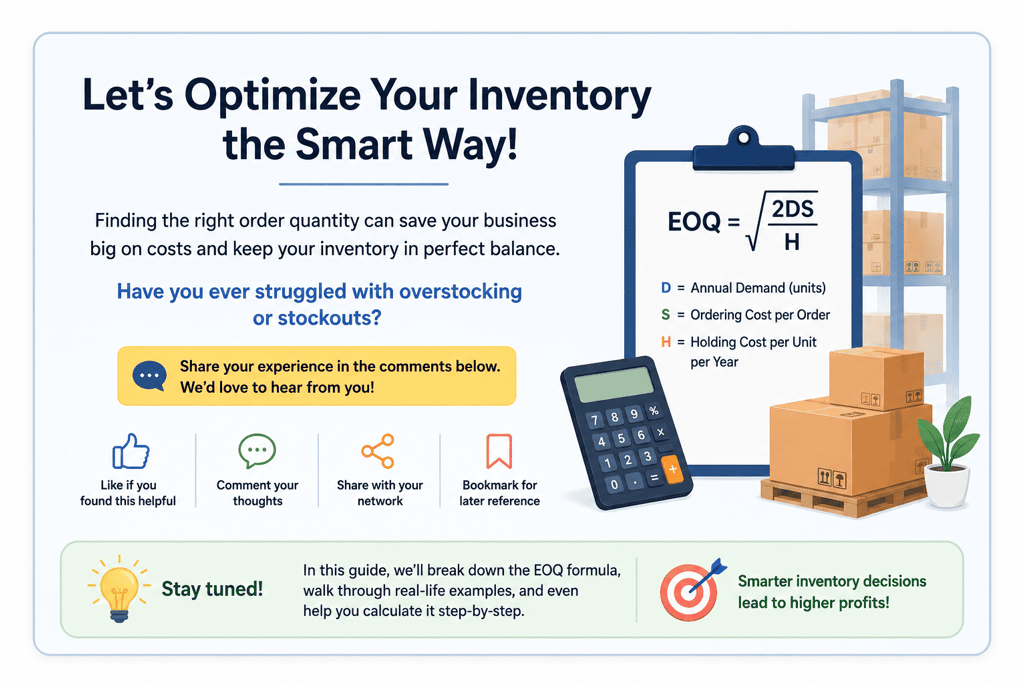
Think of EOQ as your smart calculator for ordering decisions—it helps you figure out the sweet spot between overstocking and running out. In this guide, we’ll break it down step by step: what EOQ really means, the formula behind it, how businesses use it in the real world, plus handy tables and even a simple calculator approach to make it practical.
What is Economic Order Quantity (EOQ)?
Economic Order Quantity (EOQ) is the optimal order quantity a company should purchase to minimize the total cost of inventory — including ordering costs and holding (carrying) costs.
In simple terms:
👉 EOQ answers the question — “How much should I order each time to keep costs as low as possible?”
Why EOQ is Important?
When it comes to inventory management, Economic Order Quantity (EOQ) isn’t just a formula—it’s a practical tool that keeps your business running smoothly. Think of it as the balance point between spending too much and risking too little. Here’s why it matters:
Reduce total inventory costs: EOQ helps cut down on unnecessary expenses like excess storage fees and frequent ordering costs.
Optimize cash flow: By ordering the right amount at the right time, you free up capital for other priorities instead of locking it into stock.
Improve warehouse efficiency: Fewer stock fluctuations mean smoother operations, better space utilization, and less chaos in the warehouse.
Avoid overstocking and understocking: EOQ minimizes the risk of products gathering dust or customers walking away empty‑handed.
Enhance supply chain planning: With predictable ordering cycles, your supply chain becomes more reliable and easier to manage.
In short, EOQ acts like a compass for inventory decisions—pointing you toward smarter choices that save money, boost efficiency, and keep customers happy.
EOQ Formula with Solved Calculation Example
Here’s the standard EOQ formula:
EOQ = √(2DS / H)
Where: D = Demand (units per year), S = Ordering cost (per order), H = Holding cost (per unit, per year)
EOQ Calculation Example
Let’s walk through a practical example to understand how Economic Order Quantity (EOQ) works in real business scenarios.
Annual Demand (D) - 10,000 units
Ordering Cost (S) - 500 per order
Holding Cost (H) - 20 per unit per year
EOQ = √((2 × 10,000 × 500) / 20)
EOQ = √(10,000,000 / 20)
EOQ = √500,000
EOQ ≈ 707 units
👉 Optimal Order Quantity = 707 units per order
This means the company should order 707 units each time to minimize total inventory costs.
EOQ Cost Comparison Table
To better understand why EOQ is important, let’s compare different order quantities:
👉 The EOQ point represents the lowest total cost, where ordering and holding costs are perfectly balanced.
EOQ Calculator (Manual Method)
You can easily calculate EOQ manually by following these steps:
Step 1
Multiply:
2 × Annual Demand × Ordering Cost
Step 2
Divide the result by:
Holding Cost per unit
Step 3
Take the square root of the final value
📌 Example
√((2 × 10,000 × 500) / 20)
You can calculate this using any scientific calculator or spreadsheet tool.
How to Calculate EOQ in Excel?
You can easily calculate EOQ quickly in Excel using the following setup:
Real‑World Examples of EOQ
Theory is great, but EOQ really shines when you see how businesses put it into practice. Let’s look at a few everyday scenarios:
Retail Business - Imagine a clothing retailer trying to keep up with demand for a best‑selling T‑shirt. If they order too many, racks overflow and cash gets stuck in unsold stock. If they order too few, customers leave disappointed. By applying EOQ—alongside smart choices like FIFO vs LIFO inventory methods—the retailer finds the sweet spot, ordering just enough each month to keep shelves stocked without drowning in excess inventory.
Manufacturing Industry - Think of a car manufacturer that needs steel, tires, and hundreds of components. Ordering in bulk might seem smart, but it ties up millions in raw materials. Ordering too little slows down production. EOQ helps them plan purchases so the assembly line runs smoothly while keeping costs under control—and when paired with ABC analysis in inventory management, they can also prioritize which materials matter most, ensuring high‑value items never run short.
E‑commerce Companies - Online stores live and die by fast‑moving inventory. Order too much, and storage costs eat into profits. Order too little, and delivery delays frustrate customers. EOQ gives them a data‑driven way to balance speed with efficiency, ensuring popular items are always ready to ship.
FMCG Sector - Fast‑moving consumer goods—like packaged snacks or bottled drinks—fly off the shelves daily. Companies in this sector use EOQ to manage massive volumes without overloading warehouses. It helps them keep products flowing steadily to retailers while minimizing waste and storage headaches.
EOQ isn’t just a formula—it’s a practical decision‑making tool that adapts to different industries, whether you’re selling T‑shirts, building cars, or stocking up on soft drinks.
EOQ vs Traditional Ordering
✅ Advantages of EOQ
Minimizes total inventory cost: By balancing ordering and holding costs, EOQ helps companies avoid overspending on storage or frequent reordering.
Easy to calculate and implement: The formula is straightforward, and once you plug in the numbers, it gives clear guidance on how much to order.
Improves operational efficiency: With smoother inventory cycles, warehouses run more efficiently, and supply chains stay on track.
Supports better financial planning: EOQ makes cash flow more predictable, helping businesses plan budgets and allocate resources wisely.
⚠️ Limitations of EOQ
Demand is constant: EOQ assumes customer demand doesn’t fluctuate, but in reality, demand often changes with seasons, trends, or market shifts.
Lead time is fixed: It assumes suppliers always deliver on time, which isn’t always the case.
No bulk discounts: EOQ doesn’t account for supplier discounts on large orders, which can sometimes make bulk buying more cost‑effective.
Costs remain stable: EOQ works best when holding and ordering costs stay steady, but in reality, costs can fluctuate due to inflation, fuel prices, or market conditions.
👉 That’s why EOQ should be seen as a guiding framework rather than a one‑size‑fits‑all solution. In practice, businesses often tweak the model to fit their unique situations.
📌 Best Practices for Using EOQ
EOQ works best when it’s not treated as a one‑time calculation but as part of an ongoing inventory management strategy. Here are some practical ways businesses make the most of it:
Regularly update demand forecasts Customer demand is rarely static—it shifts with seasons, trends, and market conditions. Refreshing your forecasts ensures EOQ stays accurate and relevant.
Track actual ordering and holding costs Costs can creep up without notice. By monitoring real expenses, you can fine‑tune EOQ calculations to reflect the true picture instead of outdated estimates.
Use inventory management software Manual calculations are fine for small setups, but software makes EOQ easier to apply at scale. It automates data collection, updates formulas, and integrates with supply chain systems.
Combine EOQ with safety stock planning EOQ tells you the optimal order size, but safety stock ensures you’re covered when demand spikes or suppliers delay. Together, they create a more resilient inventory plan.
Monitor seasonal demand variations From holiday rushes to off‑season slowdowns, demand cycles can throw EOQ off balance. Adjusting for seasonality keeps your inventory aligned with reality.
In short, EOQ is powerful, but it’s even more effective when paired with real‑time data, smart tools, and a flexible approach to changing market conditions.
Conclusion
Economic Order Quantity (EOQ) is one of those classic tools in inventory management that never goes out of style. At its core, it’s all about finding that sweet spot—ordering just enough to avoid constant reorders, but not so much that your warehouse starts looking like a storage jungle.
When businesses put EOQ into action, they’re not just crunching numbers—they’re unlocking smarter ways to run operations. Done right, EOQ can cut down unnecessary costs, streamline day‑to‑day efficiency, and guide better decisions across the entire supply chain.
Think of it as a balancing act: fewer headaches with stock levels, more confidence in planning, and a healthier bottom line. That’s why EOQ isn’t just a formula—it’s a practical strategy that helps companies stay lean, agile, and ready for growth.
Frequently asked questions
What is EOQ in simple terms?
EOQ is the ideal quantity a company should order to minimize total inventory costs.
What is the EOQ formula?
EOQ = √(2DS / H)
What happens if EOQ is too high?
Higher holding costs and risk of unsold inventory.
Can EOQ be used for all businesses?
Yes, but it works best when demand and costs are relatively stable.