FIFO vs LIFO in Inventory Accounting: Differences, Benefits & Real Examples
Confused about FIFO vs LIFO in accounting? Learn key differences, real examples, advantages, and choose the best inventory valuation method for your business.
What is FIFO (First-In, First-Out)?
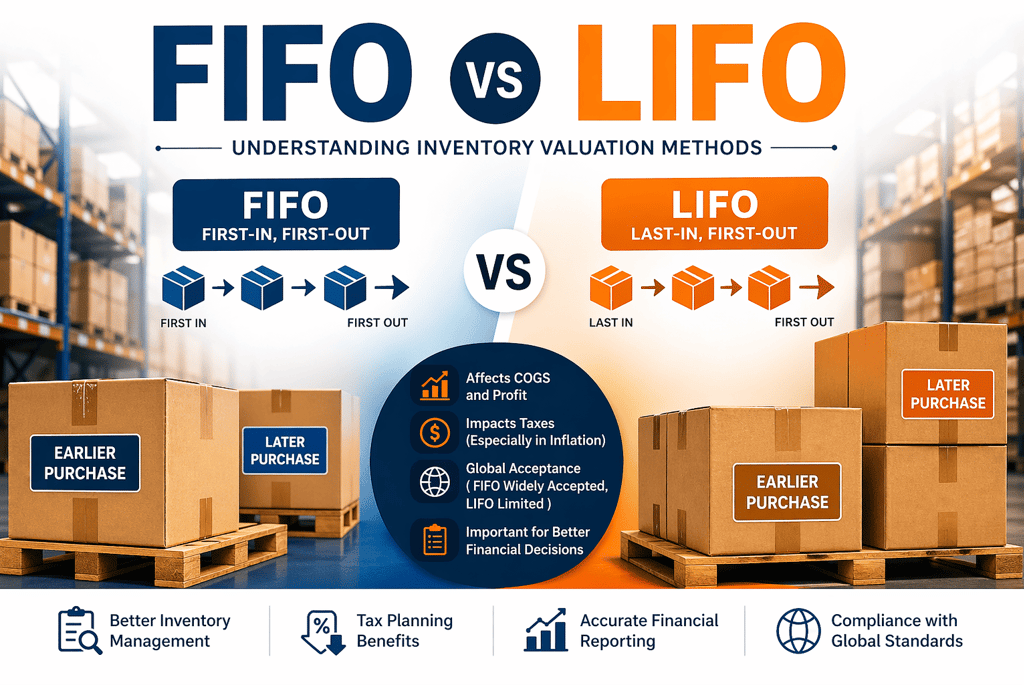
FIFO assumes that the oldest inventory items are sold or used first. In other words, the first products you purchase are the first ones to leave your inventory.
Example of FIFO
Let’s say a company purchases inventory in the following order:
100 units at $10 each
100 units at $12 each
If the company sells 100 units, under FIFO:
The cost of goods sold (COGS) = 100 units × $10 = $1,000
Remaining inventory = 100 units at $12
Key Characteristics of FIFO
Inventory reflects recent (current) prices
COGS reflects older (historical) costs
Often aligns with the physical flow of goods (especially perishable items)
What is LIFO (Last-In, First-Out)?
LIFO assumes that the most recently purchased inventory is sold first. The latest items added to inventory are the first ones to be used or sold.
Example of LIFO
Using the same data:
100 units at $10 each
100 units at $12 each
If the company sells 100 units, under LIFO:
COGS = 100 units × $12 = $1,200
Remaining inventory = 100 units at $10
Key Characteristics of LIFO
Inventory reflects older (historical) costs
COGS reflects recent (current) costs
Often used for financial and tax benefits in certain regions
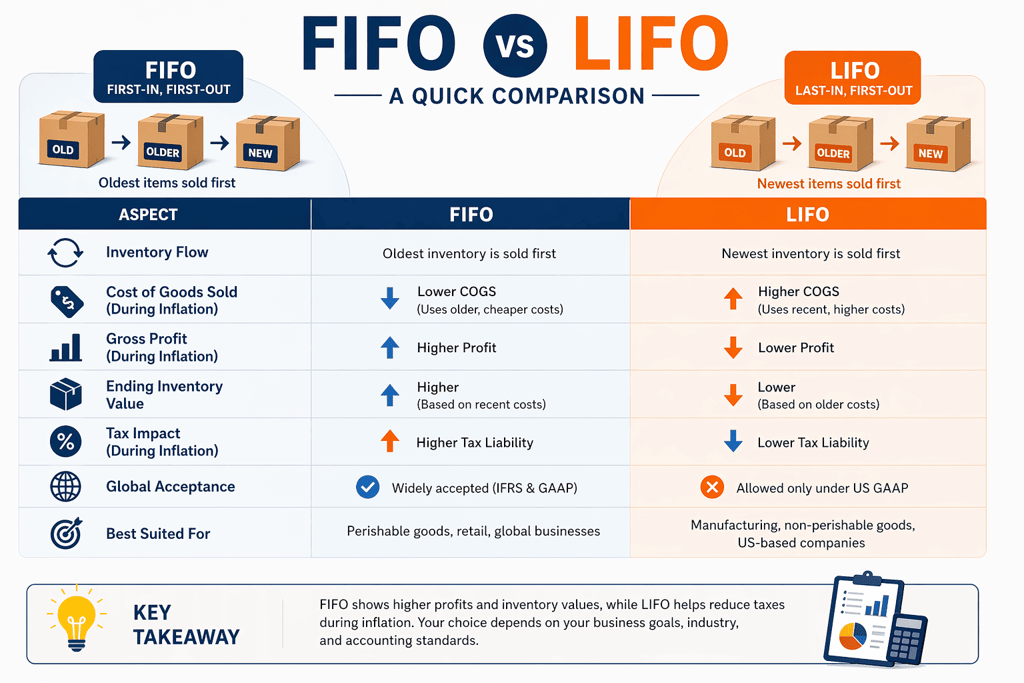
FIFO vs LIFO: Key Differences
Impact of Inflation
The difference between FIFO and LIFO becomes more significant during inflation (when prices are rising).
Under Inflation:
FIFO:
Uses older, cheaper costs for COGS
Results in higher profit
Leads to higher taxes
LIFO:
Uses recent, higher costs for COGS
Results in lower profit
Leads to lower taxes
This is one of the main reasons companies choose LIFO where it is allowed.
Global Accounting Perspective
One critical factor to understand is that LIFO is not permitted under International Financial Reporting Standards (IFRS), which are used in most countries worldwide.
FIFO is accepted globally under both IFRS and GAAP
LIFO is allowed under US GAAP, but not under IFRS
What this means:
Companies operating internationally typically use FIFO
Multinational firms often avoid LIFO to maintain consistency across countries
Advantages of FIFO
1. Better Reflection of Inventory Value
Ending inventory is based on recent costs, making it closer to current market value.
2. Simplicity and Logical Flow
FIFO aligns with the natural movement of goods, especially in industries like food, pharmaceuticals, and retail.
3. Higher Profit Reporting
During inflation, FIFO results in higher profits, which can be beneficial for investors and stakeholders.
Disadvantages of FIFO
1. Higher Tax Burden
Higher profits mean higher taxable income.
2. Less Matching of Current Costs
COGS reflects older costs, which may not match current revenue levels.
Advantages of LIFO
1. Tax Benefits
Lower profits during inflation lead to lower taxes.
2. Better Matching Principle
COGS reflects current costs, providing a more realistic view of profitability.
Disadvantages of LIFO
1. Not Globally Accepted
LIFO is banned under IFRS, limiting its use internationally.
2. Outdated Inventory Valuation
Ending inventory may be valued at very old costs, making balance sheets less realistic.
3. Complexity
Maintaining LIFO layers can be complicated, especially for large inventories.
Where this is getting applied?
FIFO is commonly used in:
Retail (e.g., supermarkets)
Food and beverage industries
Pharmaceuticals
E-commerce businesses
LIFO is often used in:
Manufacturing companies (in the U.S.)
Industries dealing with non-perishable goods
Businesses looking to reduce tax liability during inflation
📦 Real-World Example: FIFO vs LIFO (Amazon Warehouse)
🟢 FIFO Example (What Amazon Mostly Follows)
Imagine Amazon stores wireless headphones in its warehouse:
January stock: 100 units at ₹1,000 each
February stock: 100 units at ₹1,200 each
Now, a customer places an order for 150 units.
👉 Using FIFO:
First 100 units sold from January stock (₹1,000)
Next 50 units sold from February stock (₹1,200)
Result:
Cost of Goods Sold (COGS) is lower
Remaining inventory is valued at newer (higher) cost
Products shipped are older stock → better for avoiding dead stock
📌 This is ideal for Amazon because it deals with fast-moving and sometimes perishable or trend-sensitive products.
🔴 LIFO Example (Hypothetical Scenario at Amazon)
Using the same example:
January stock: 100 units at ₹1,000
February stock: 100 units at ₹1,200
👉 Using LIFO:
First 100 units sold from February stock (₹1,200)
Next 50 units sold from January stock (₹1,000)
Result:
Higher COGS (because recent stock is more expensive)
Lower profit (useful for tax savings in some countries)
Older inventory (January stock) remains in warehouse → risk of obsolescence
📌 This is not ideal for Amazon’s model, as unsold older items can lead to:
Product damage
Expiry (for certain categories)
Customer dissatisfaction
⚖️ Key Takeaway (Amazon Context)
Amazon primarily operates closer to FIFO in practice
This ensures:
Faster inventory turnover
Better customer experience
Reduced waste and storage costs
Which Method Should You Choose?
At the end of the day, whether you go with FIFO or LIFO really comes down to timing, the type of items you’re dealing with, and what makes the most sense for your business. There’s no one‑size‑fits‑all answer—it’s about picking the method that fits your situation best.
Choose FIFO if:
You operate globally
You want accurate inventory valuation
You deal with perishable goods
You follow IFRS
Choose LIFO if:
You operate in the United States
You want to reduce taxable income
Your inventory costs are rising significantly
FIFO vs LIFO: Quick Summary
FIFO sells older inventory first → Higher profits, higher taxes
LIFO sells newer inventory first → Lower profits, lower taxes
FIFO is globally accepted → LIFO is restricted
FIFO shows realistic inventory value → LIFO focuses on tax efficiency
Final Thoughts
FIFO and LIFO are more than just accounting methods—they directly impact how businesses report profits, manage taxes, and present financial health.
For a global audience, FIFO is generally the preferred and more practical method, given its widespread acceptance and alignment with real-world inventory flow. However, LIFO still plays a strategic role in regions like the United States, especially for companies looking to manage tax exposure during inflationary periods.
Understanding both methods allows businesses to make informed decisions that align with their operational, financial, and regulatory needs.
If you're building expertise in supply chain or planning to optimize your inventory strategy, mastering concepts like FIFO and LIFO is a strong foundation for long-term success.