
ABC Analysis in Inventory Management: Ultimate 2026 Guide with Examples, Formula & Benefits
Master ABC Analysis in inventory management with simple explanations, formula, real examples, and benefits. Improve inventory control and reduce costs easily.
What is ABC Analysis?
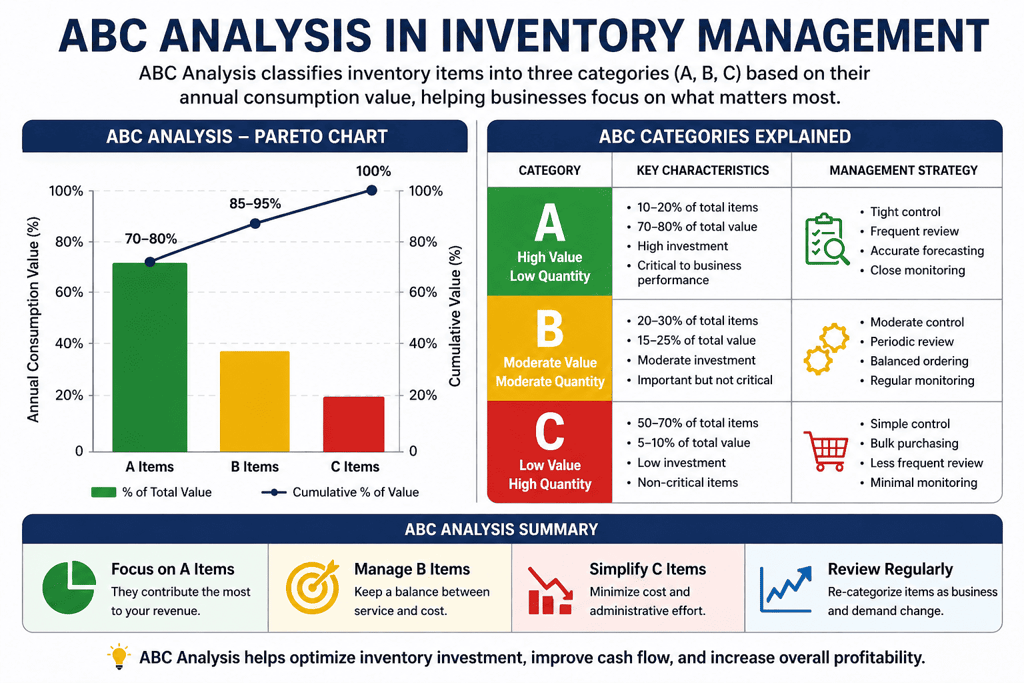
ABC Analysis is an inventory management technique that categorizes items into three groups (A, B, and C) based on their value and importance. Category A items are high-value with low quantity, while Category C items are low-value with high quantity.
Category A: High-value items with low frequency
Category B: Moderate value and frequency
Category C: Low-value items with high frequency
This classification is based on the Pareto Principle (80/20 rule), which suggests that a small percentage of items contribute to the majority of the value.
Efficient inventory management is one of the most critical factors that determine the success of any business dealing with physical goods. Whether you're running a small eCommerce store or managing a large manufacturing enterprise, not all inventory items contribute equally to your revenue.
This is where ABC Analysis comes in.
ABC Analysis is a powerful inventory categorization technique that helps businesses prioritize their resources, optimize stock levels, and improve profitability. By focusing on the most valuable items, companies can make smarter decisions and reduce unnecessary costs.
In this guide, we will explore ABC Analysis in depth—its meaning, principles, benefits, limitations, and how to implement it effectively.
Simple Example:
20% of items (Category A) generate ~80% of revenue
30% of items (Category B) generate ~15% of revenue
50% of items (Category C) generate ~5% of revenue
Why ABC Analysis is Important
ABC Analysis helps businesses focus their time, effort, and capital where it matters the most. By focusing on high-value and high-impact items, businesses can optimize their inventory strategy, reduce costs, and improve overall supply chain performance. This approach is widely used across industries such as retail, manufacturing, and e-commerce to make smarter, data-driven decisions.
Key Benefits
1. Better Inventory Control
ABC Analysis allows businesses to implement differentiated inventory control strategies. High-value “A” category items require close monitoring, frequent stock checks, and accurate demand forecasting, while “B” and “C” items can be managed with more relaxed controls.
This targeted approach ensures that critical inventory is always available while minimizing unnecessary administrative effort on low-priority items. As a result, businesses can maintain optimal stock levels without overcomplicating their inventory processes.
2. Cost Optimization
One of the biggest advantages of ABC Analysis is its ability to reduce overall inventory costs. By identifying low-value “C” items, businesses can avoid overstocking products that do not significantly contribute to revenue.
This helps in lowering holding costs such as storage, insurance, and handling expenses. Additionally, companies can negotiate better purchasing terms for high-value items and reduce waste caused by obsolete or slow-moving inventory.
3. Improved Decision-Making
ABC Analysis provides valuable insights that support better decision-making across procurement, sales, and inventory management. Managers can clearly identify which products generate the most value and should be prioritized.
With this information, businesses can make informed decisions about purchasing quantities, supplier selection, pricing strategies, and promotional activities. It also helps in identifying underperforming products that may need to be discontinued or replaced.
4. Efficient Resource Allocation
Time, workforce, and financial resources are limited in any organization. ABC Analysis ensures that these resources are allocated where they deliver the highest return.
For example, more time and attention can be given to managing “A” category items, while automation or simplified processes can handle “B” and “C” items. This leads to improved productivity, better workforce utilization, and more efficient operations overall.
5. Reduced Risk of Stockouts
Stockouts of high-value or critical items can lead to lost sales, dissatisfied customers, and damage to brand reputation. ABC Analysis helps mitigate this risk by ensuring that “A” category items are closely tracked and replenished on time.
By maintaining accurate inventory levels and setting appropriate reorder points for important products, businesses can ensure consistent product availability and improve customer satisfaction.
Categories in ABC Analysis Explained
Category A: High Value, Low Quantity
Represents 10–20% of inventory items
Contributes 70–80% of total inventory value
Requires strict monitoring and control
Every business juggles a mix of items in its inventory, and not all of them contribute equally to the bottom line. A smart way to make sense of this is to first line them up from high to low in terms of value. Then, take those high‑value items and sort them again—this time from low to high in quantity. What you’ll uncover are the products that bring in the most revenue even though they’re stocked in smaller numbers. Those gems fall into what’s called Category A.
Management Strategy:
Frequent review
Accurate forecasting
Tight security and tracking
Category B: Moderate Value and Quantity
Represents 20–30% of inventory
Contributes 15–25% of value
After identifying your top‑tier Category A items, the next layer down is Category B. These are products that still contribute significantly to your revenue, but not quite at the same level as the A group. Think of them as the steady performers—usually moderate in both value and quantity. They’re not the rare gems that drive huge profits in small numbers, but they’re reliable contributors that deserve attention. Businesses often keep a closer eye on these items to balance stock levels and ensure they don’t slip into underperformance. In short, Category B is about maintaining consistency and supporting the backbone of your inventory.
Management Strategy:
Moderate control
Periodic review
Balanced ordering
Category C: Low Value, High Quantity
Represents 50–70% of inventory
Contributes only 5–10% of value
Finally, we come to Category C—the long tail of your inventory. These are the items that contribute the least to overall revenue. They’re usually low‑value products, often stocked in larger quantities, but their impact on the business is relatively small. Think of them as the supporting cast: they’re necessary to keep operations running smoothly, but they don’t drive big profits. Because of their lower contribution, businesses often manage Category C items with simpler controls, focusing on efficiency and cost savings rather than tight monitoring. In short, Category C is about keeping the basics in check without overcomplicating things.
Management Strategy:
Simple controls
Bulk ordering
Less frequent monitoring
How ABC Analysis Works (Step-by-Step)
Step 1: Calculate Annual Consumption Value
For each item:
Consumption Value = Annual Demand × Cost per Unit
Step 2: Sort Items
Arrange all inventory items in descending order based on their consumption value.
Step 3: Calculate Cumulative Percentage
Determine:
% of total value
% of total items
Step 4: Categorize Items
Divide into:
A (Top 70–80% value)
B (Next 15–25%)
C (Last 5–10%)
Step 5: Apply Control Policies
Assign different inventory management strategies for each category.
Real-World Example of ABC Analysis
Let’s consider an online retail store:
In this table, ABC Analysis clearly shows how different products contribute differently to total inventory value:
Smartphones (Category A)
These generate the highest revenue despite being fewer in number. They require tight control, accurate forecasting, and frequent monitoring.Headphones (Category B)
These fall into the mid-range category. They need balanced inventory management with periodic review.Charging Cables (Category C)
These are low-value but high-volume items. They can be managed with simple controls and bulk ordering.
Key Insight
Even though charging cables may sell more frequently, smartphones contribute the most to revenue. This is why businesses should focus more on Category A items for profitability.
Advantages of ABC Analysis
✔ Simplifies Inventory Management
✔ Improves Cash Flow
✔ Enhances Operational Efficiency
✔ Supports Strategic Planning
Limitations of ABC Analysis
While powerful, ABC Analysis has some drawbacks:
❌ Ignores Demand Variability
High‑value items don’t always enjoy steady demand—it can rise and fall over time. That’s why tracking becomes so important. Businesses need to keep an eye on these shifts and update their categories regularly, making sure the classification reflects the latest demand patterns.
❌ Not Suitable Alone
ABC classification works even better when you pair it with other inventory techniques like FIFO, LIFO, or EOQ. And if you want to get more precise, you can layer in XYZ classification too. For example, you can mark ‘A’ as high‑value and then use X, Y, Z to show how often those items move. So AX means high‑value but low‑frequency, AY means high‑value with medium frequency, and AZ means high‑value with high frequency. This combo approach is super handy when you’re managing a wide range of items in your inventory—it gives you a sharper picture of what really drives your business.
❌ Time-Consuming Setup
Getting your inventory classification right isn’t just about labeling items—it starts with some serious data crunching. You need to dig into the details: sales numbers, demand patterns, stock levels, and even how often items move in and out. This initial analysis lays the foundation for everything that follows. Without it, your categories risk being off‑track. Think of it as building a house—you wouldn’t skip the blueprint stage, right? In the same way, businesses need to invest time in analyzing their data upfront so that the ABC (or any other) classification truly reflects reality.
❌ Static Classification
Inventory categories aren’t set in stone—they evolve as your business does. Demand patterns shift, customer preferences change, and even market conditions can throw surprises your way. That’s why it’s important to revisit your classifications regularly. What was once a top‑tier item might slide down the list, while something overlooked could suddenly become a star performer. By keeping your categories updated over time, businesses stay aligned with reality instead of relying on outdated assumptions. Think of it like refreshing your playlist—you wouldn’t keep listening to the same songs forever, so why treat your inventory any differently?
Best Practices for Implementing ABC Analysis
1. Update Regularly
Re-evaluate categories monthly or quarterly.
2. Use Automation Tools
Inventory management software can simplify calculations.
3. Combine with Other Methods
Use with demand forecasting and safety stock planning.
4. Train Your Team
Ensure staff understands category importance.
5. Customize Based on Business
Adjust thresholds (A, B, C percentages) as per your needs.
Here’s a quick comparison of the most important inventory management methods
This table compares four widely used inventory management techniques:
ABC Analysis helps businesses prioritize high-value items
FIFO (First-In, First-Out) ensures older stock is sold first, ideal for perishable goods
JIT (Just-in-Time) minimizes inventory by ordering only when needed
EOQ (Economic Order Quantity) calculates the optimal order size to reduce costs
ABC analysis is widely used across industries like Retail, Manufacturing, Healthcare, eCommerce, Warehousing etc.,
Who Should Use ABC Analysis?
ABC Analysis is useful for:
Business owners
Supply chain managers
Inventory planners
eCommerce sellers
Logistics professionals
Conclusion
ABC Analysis is one of those practical tools that can really simplify inventory management. By grouping items based on their importance, businesses can zero in on what actually drives revenue and profits. Instead of spreading energy across every single product, ABC helps you work smarter—giving priority to the high‑impact items while keeping low‑value stock easy to manage.
And here’s the best part: when you combine ABC with other inventory techniques, it turns into a powerhouse strategy. You’ll not only boost efficiency but also cut down costs and strengthen your overall supply chain performance. It’s like upgrading from a basic toolkit to a full‑blown system that keeps your operations sharp and future‑ready.