

Putaway Strategy in Warehouse: SOP, Methods, Calculations & Excel Template (2026)
Learn warehouse putaway strategy with SOP, methods, calculations, and Excel template. Improve storage efficiency, reduce travel time, and optimize warehouse operations.
Supply Chain Navigator
6/1/20266 min read
Efficient warehouse operations thrive on how swiftly and accurately goods are stored after receiving. That’s why a well-structured putaway strategy is essential.
When putaway is poorly managed, warehouses face congestion, higher labor costs, and frequent inventory errors. In contrast, a systematic approach maximizes storage utilization, minimizes travel time, and boosts overall productivity.
This comprehensive guide will walk you through everything you need to know about warehouse putaway strategy — from methods and SOPs to calculations, KPIs, and even an Excel-based approach for practical implementation. If you’re new to warehouse operations, you can also explore our detailed guide on inventory management for warehouses to understand how storage and stock control work together.
What is Putaway in Warehouse?
Putaway refers to the movement of goods from the receiving area to their assigned storage locations within a warehouse.
It serves as the critical link between inbound logistics and storage operations, ensuring that inventory is placed in the most efficient location for accessibility and accuracy. This process becomes even more effective when aligned with a structured warehouse KPI framework, which helps track efficiency across operations.
Why Putaway Strategy is Important?
A well‑planned putaway strategy is more than just moving goods into storage — it’s the foundation of warehouse efficiency. Here’s how it makes a difference:
Reduce travel time and labor cost By assigning items to the nearest or most logical storage location, workers spend less time walking and handling goods, which directly lowers labor expenses.
Improve space utilization Strategic placement ensures every inch of warehouse space is used effectively, preventing wasted capacity and allowing for smoother expansion.
Minimize congestion in warehouse aisles Organized putaway reduces traffic bottlenecks, keeping aisles clear and operations flowing without unnecessary delays.
Enhance picking efficiency When goods are stored in logical, accessible locations, order picking becomes faster and more accurate, improving customer satisfaction. Efficient picking is closely tied to how well inventory levels are managed—learn how in our Min-Max Inventory System guide.
Reduce inventory errors Properly mapped storage locations lower the risk of misplaced items, ensuring inventory records remain reliable.
Without a structured strategy, warehouses often fall into random storage practices. This leads to wasted space, longer travel times, higher costs, and frequent inaccuracies — all of which ripple across operations and hurt overall productivity.
Types of Putaway Strategies
1. Fixed Location Putaway
In this method, each SKU is permanently assigned to a predefined storage location.
Best for: Stable‑demand products and high‑value items that require consistent tracking.
Pros: Easy to locate items quickly since workers always know where to find them.
Cons: Space utilization is often poor, as fixed slots may remain empty when demand fluctuates.
2. Random Putaway
Goods are stored in any available space without predefined assignments.
Best for: Warehouses with a high variety of SKUs and frequent stock rotation.
Pros: Maximizes space utilization by filling gaps dynamically.
Cons: Requires a robust Warehouse Management System (WMS) to track item locations accurately.
3. Directed Putaway
Here, the system suggests the most optimal storage location based on predefined rules such as product type, size, or turnover rate.
Best for: Medium to large warehouses with diverse inventory.
Pros: Balances efficiency and flexibility by combining system intelligence with operational needs.
Cons: Relies heavily on system support and accurate data inputs.
4. Zone-Based Putaway
The warehouse is divided into zones, each dedicated to specific product categories (e.g., FMCG, pharmaceuticals, perishables).
Best for: Categorized inventory where grouping improves accessibility and compliance.
Pros: Simplifies picking and replenishment by clustering similar items together.
Cons: May reduce flexibility if zones are not well‑balanced or demand shifts unexpectedly.
5. ABC Putaway Strategy
Products are stored based on demand frequency, following the ABC classification model.
A items: High‑demand products stored near the dispatch area for quick access.
B items: Moderate‑demand products placed at mid‑distance locations.
C items: Low‑demand products stored in far or less accessible locations.
Pros: Improves picking speed for high‑impact items and aligns storage with demand patterns.
Cons: Requires regular review and reclassification as demand changes over time.
ABC classification is widely used in inventory control—read our complete ABC analysis and inventory classification guide to dive deeper.
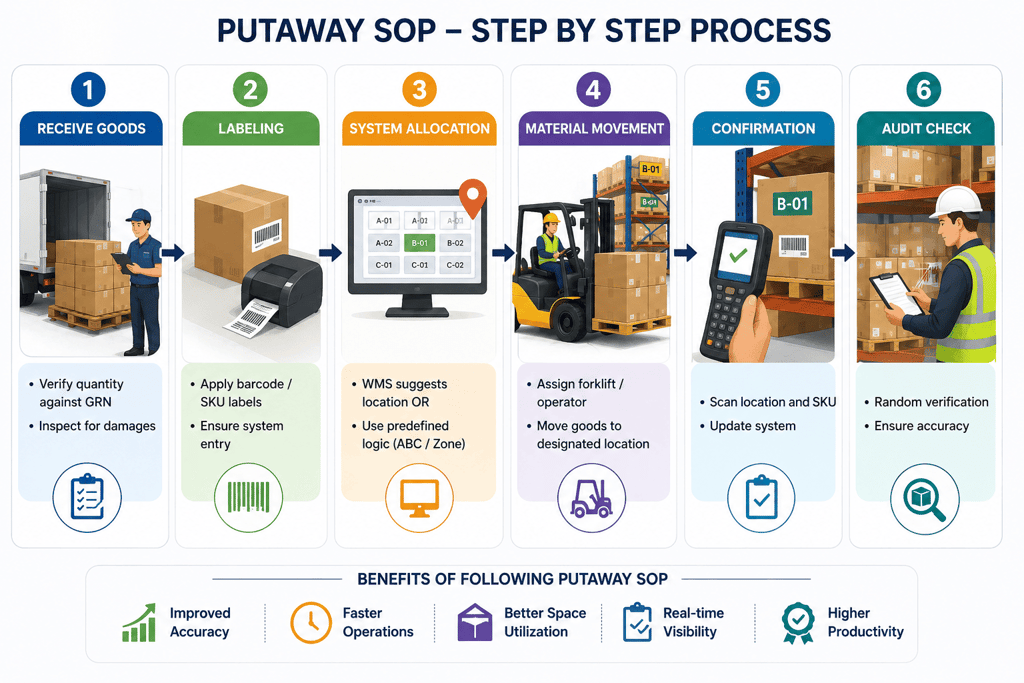
Standard Operating Procedure (SOP) for Putaway
Step 1: Receive Goods
Verify quantity against GRN
Inspect for damages
Step 2: Labeling
Apply barcode / SKU labels
Ensure system entry
Step 3: System Allocation
WMS suggests location OR
Use predefined logic (ABC / Zone)
Step 4: Material Movement
Assign forklift / operator
Move goods to designated location
Step 5: Confirmation
Scan location and SKU
Update system
Step 6: Audit Check
Random verification
Ensure accuracy
To ensure consistency and performance tracking, many warehouses integrate this SOP with a warehouse KPI dashboard for real-time monitoring.
Key Putaway Calculations
1. Putaway Time
Putaway Time = Travel Time + Handling Time + System Time
2. Space Utilization %
Space Utilization = (Used Space / Total Available Space) × 100
3. Putaway Productivity
Putaway Productivity = Total Units Putaway / Labor Hours
4. Travel Distance Optimization
Average Distance = Total Distance Travelled / Number of Trips
5. Putaway Accuracy %
Accuracy = (Correct Putaway / Total Putaway) × 100
Excel Template Structure (DIY)
You can build a simple putaway tracking Excel with the following columns:
| Date | SKU | Quantity | Received Location | Putaway Location | Time Taken | Operator | Status |
Advanced Columns:
Distance (meters)
Putaway Time (minutes)
Errors (Yes/No)
Zone
ABC Category
Sample Excel Formula Ideas
Calculate Time Efficiency = Quantity / Time Taken
Space Utilization = Used Space / Total Space
Error Rate = Errors / Total Transactions
While you can build this template manually using the structure above, it may take time to set up formulas and formatting correctly. To make things easier, I’ve created a ready-to-use Putaway Excel Template with built-in formulas and KPI tracking.
👉 Download the free template here and start tracking immediately
Best Practices for Putaway Strategy
Use ABC classification regularly Classify items into A, B, and C categories based on demand frequency. This ensures high‑demand items are stored closer to dispatch areas, reducing picking time and improving service levels. Regular reviews keep the classification aligned with changing demand patterns.
Minimize travel distance using layout optimization Design warehouse layouts so that frequently picked items are positioned near receiving and dispatch zones. This reduces operator walking time, forklift usage, and overall labor costs.
Implement barcode scanning Barcode or RFID scanning ensures accurate identification of SKUs during putaway. It reduces human error, improves inventory accuracy, and speeds up system updates.
Use WMS for directed putaway A Warehouse Management System can suggest optimal storage locations based on rules like product type, turnover rate, or zone allocation. This balances efficiency, space utilization, and accuracy. Choosing the right system is crucial—here’s a list of best warehouse management tools for small businesses.
Train operators on SOP Well‑trained staff ensure consistency in following putaway procedures. Training reduces mistakes, improves safety, and enhances productivity across shifts.
Review slotting periodically Slotting analysis helps identify whether items are stored in the most efficient locations. Regular reviews allow adjustments based on seasonal demand, new product introductions, or changes in order patterns.
Common Challenges in Putaway Strategy
Poor warehouse layout Inefficient layouts lead to longer travel distances, congestion in aisles, and wasted space. Without a logical flow from receiving to storage, operators spend more time moving goods, which slows down operations and increases costs.
Lack of system integration When Warehouse Management Systems (WMS), barcode scanners, and ERP platforms are not integrated, data entry becomes manual and error‑prone. This disconnect results in misplaced items, inaccurate inventory records, and delays in order fulfillment.
Manual errors Human mistakes such as mislabeling, incorrect scanning, or placing goods in the wrong location can ripple across operations. These errors cause inventory mismatches, picking delays, and customer dissatisfaction.
Space constraints Limited storage capacity forces warehouses to adopt inefficient practices like random stacking or overloading aisles. This not only reduces accessibility but also increases safety risks for operators.
Unplanned inbound volumes Sudden spikes in inbound shipments overwhelm receiving and putaway processes. Without forecasting and flexible slotting, warehouses face bottlenecks, congestion, and delays in moving goods to storage.
KPIs to Track Putaway Efficiency
Putaway cycle time
Labor productivity
Space utilization
Accuracy rate
Dock-to-stock time
If you want a ready-to-use format, check out our warehouse KPI dashboard template with examples.
Real‑World Example: How ABC Putaway Transformed a Warehouse
Let’s look at a warehouse that decided to revamp its operations using an ABC putaway strategy. Instead of treating all products the same, they classified items into A, B, and C categories based on demand frequency.
The results were impressive:
Travel time dropped by 30% — because high‑demand “A” items were stored closer to dispatch, workers didn’t have to walk long distances for every order.
Labor costs fell by 18% — fewer hours spent moving goods meant leaner operations and better use of manpower.
Picking time improved by 25% — orders were fulfilled faster, leading to happier customers and smoother workflows.
This case shows how a simple change in putaway strategy can ripple across the entire warehouse. By aligning storage with demand, the warehouse not only saved time and money but also boosted efficiency in downstream processes like picking and shipping.
In short, smart putaway isn’t just about where you keep your goods — it’s about how you unlock productivity across the supply chain.
Conclusion
A strong putaway strategy goes beyond simply storing goods — it’s about streamlining the entire warehouse workflow.
Whether you’re managing a small warehouse or a large distribution hub, adopting structured SOPs, monitoring KPIs, and making data‑driven decisions can dramatically boost efficiency.
You can begin with straightforward tools like Excel tracking to monitor performance, and then gradually transition toward automation and WMS optimization for smarter, scalable operations.
Frequently asked questions
What is a putaway strategy in warehouse management?
A putaway strategy in warehouse management is a systematic approach used to store goods in the most optimal location after receiving. It helps improve space utilization, reduce travel time, and enhance picking efficiency.
How does putaway strategy improve warehouse efficiency?
A proper putaway strategy:
Reduces travel distance
Improves labor productivity
Optimizes storage space
Enhances inventory accuracy
It directly impacts overall warehouse performance and cost savings.
What is the difference between putaway and storage in a warehouse?
Putaway refers to the process of moving goods to storage locations, while storage refers to keeping goods in assigned locations until they are picked or shipped.
What is directed putaway in warehouse operations?
Directed putaway is a system-driven process where a Warehouse Management System (WMS) suggests the best storage location based on rules like space availability, product type, or demand frequency.
How do you calculate putaway time in a warehouse?
Putaway Time = Travel Time + Handling Time + System Processing Time
Reducing travel time is the most effective way to improve efficiency.