

Cycle Count in Warehouse: Complete Guide to Inventory Accuracy (2026)
Struggling with inventory errors? Discover the methods for cycle count, real examples, and proven tips to achieve near-perfect warehouse accuracy without disrupting operations.
Supply Chain Navigator
6/6/20268 min read
Inventory accuracy is the heartbeat of efficient warehouse operations. But let’s be real—many businesses constantly wrestle with mismatched stock counts, items going missing, or those dreaded surprise stockouts.
That’s exactly where cycle counting steps in.
Instead of halting everything for a massive full-scale audit, cycle counting keeps your inventory in check on a rolling basis. It’s like doing small, regular health checkups for your warehouse—no disruption, just steady accuracy.
In this guide, we’ll break down cycle counting in inventory management techniques: what it means, the different methods, how the process works, and the best practices to make it a game-changer for your operations.
What is Cycle Counting?
Cycle counting is an inventory auditing method where a small subset of inventory is counted on a regular basis instead of counting the entire inventory at once. Unlike annual physical inventory counts, cycle counting is done daily, weekly, or monthly, ensuring continuous inventory accuracy.
Example:
Instead of counting 10,000 SKUs at once, you count:
200 items daily
Rotate categories weekly
This approach reduces errors and improves operational efficiency.
Why is Cycle Counting Important in Warehouses?
Cycle counting isn’t just a nice-to-have—it’s a cornerstone of modern warehouse management. In today’s fast-paced supply chains, accuracy and efficiency can make or break operations, and cycle counting helps keep everything on track.
1.Improved Inventory Accuracy
Regular checks mean errors don’t pile up. By catching mismatches early, warehouses avoid the chaos of missing items, wrong SKUs, or surprise stockouts. Think of it as a continuous tune-up for your inventory system.
2.Reduced Operational Disruption
Traditional audits often mean shutting down operations—a nightmare for busy warehouses. Cycle counting, on the other hand, happens in the background. Your team keeps working, orders keep flowing, and accuracy improves without downtime.
3.Better Demand Planning
Forecasting only works if your data is reliable. With cycle counting, inventory records stay sharp, giving planners the confidence to predict demand, manage replenishment, and avoid costly overstocking or understocking.
4.Lower Financial Losses
Shrinkage, theft, and misplaced items quietly drain profits. Cycle counting helps spot these issues quickly, reducing financial leakage and protecting margins.
5.Increased Customer Satisfaction
Few things frustrate customers more than delayed or incorrect orders. By keeping inventory accurate, cycle counting ensures products are available when promised—leading to fewer errors, faster fulfillment, and happier customers.
Cycle counting isn’t just about numbers—it’s about building trust, efficiency, and resilience in warehouse operations. Done right, it transforms inventory management from a headache into a competitive advantage.
Cycle Count vs Physical Inventory Count
When it comes to keeping inventory accurate, warehouses usually rely on two main approaches: cycle counting and physical counting. Both aim to ensure your stock records match reality, but they work very differently.
Cycle counting is the modern, agile approach, while physical counting is the traditional, heavy-duty method. Most warehouses today lean on cycle counting to stay efficient, but physical counts still play a role for compliance or year-end audits.
Types of Cycle Counting Methods
Different warehouses don’t all follow the same playbook. The right cycle counting method often depends on inventory size, complexity, and business priorities. Let’s break down the most common approaches:
1.ABC Cycle Counting
This is hands-down the most popular method. It’s based on the classic ABC inventory classification:
A Items → High-value products that need frequent checks (often weekly).
B Items → Mid-value items, counted less often (monthly).
C Items → Low-value stock, checked occasionally (quarterly).
By focusing more attention on the items that matter most to revenue, warehouses can balance accuracy with efficiency.
2.Random Sampling Method
Here, items are picked at random for counting.
✔ Great for small warehouses or quick spot checks. ❌ Not ideal for large, complex inventories since randomness can miss critical items.
Think of it as a “dip test” for inventory health—fast but not always comprehensive.
3.Control Group Method
This method zeroes in on a fixed group of SKUs that are counted repeatedly over time.
✔ Helps track accuracy trends and measure how well processes are working. It’s like having a test batch that acts as a benchmark for overall inventory performance.
4.Opportunity-Based Cycle Counting
Instead of scheduling counts, this method piggybacks on existing warehouse activities. Items are counted during:
Putaway
Picking
Replenishment
✔ Highly efficient because it integrates counting into everyday workflows. It’s real-time, seamless, and ensures accuracy without adding extra steps.
Cycle counting isn’t one-size-fits-all. Some warehouses stick to ABC for structure, while others blend methods—like combining opportunity-based counts with control groups—to get the best of both worlds.
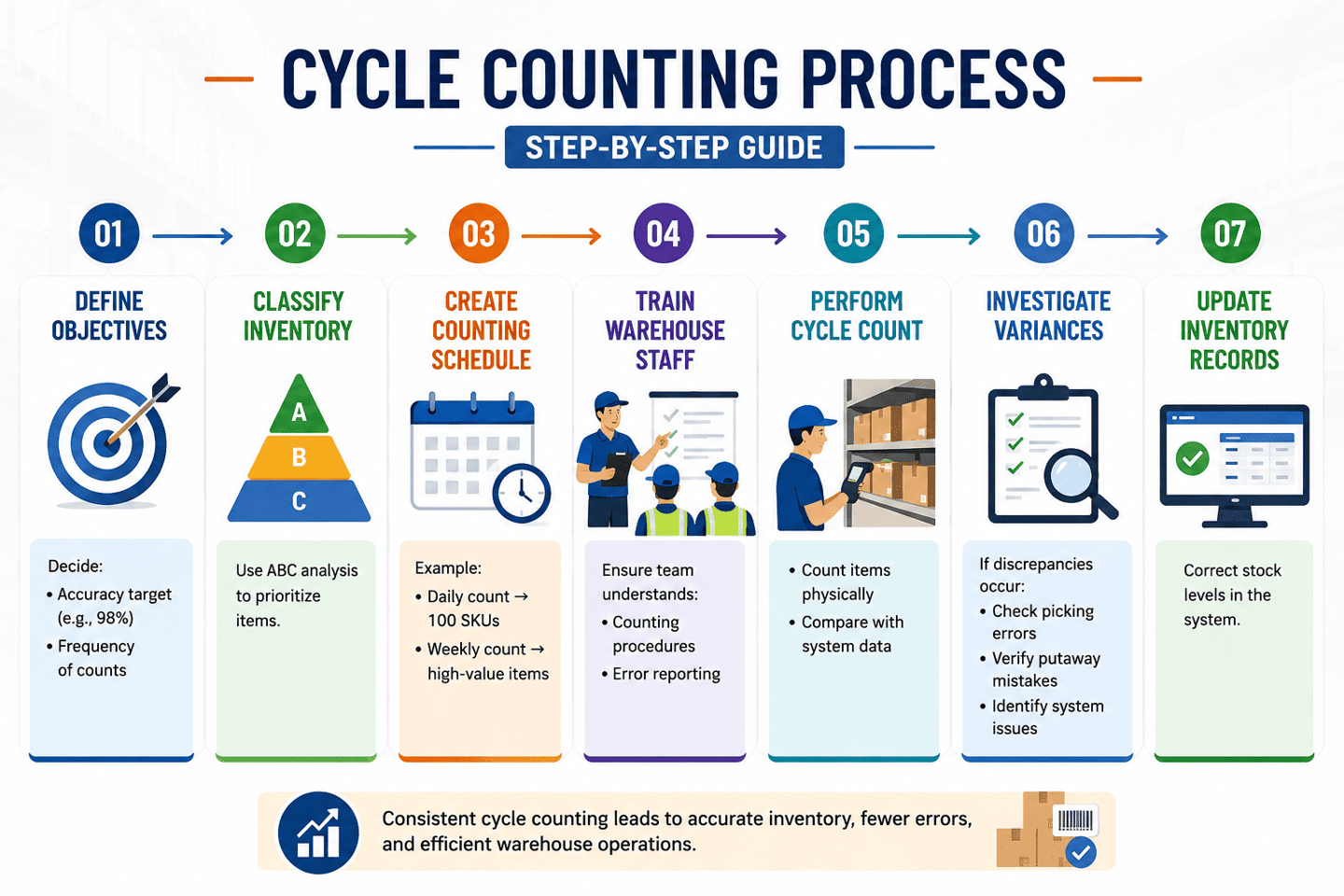
Cycle Counting Process: Step-by-Step Guide
Getting cycle counting right isn’t just about ticking boxes—it’s about building a reliable rhythm that keeps your warehouse running smoothly. Here’s how to nail it, step by step:
Step 1: Define Objectives
Start with clarity. Decide what success looks like:
Accuracy target (e.g., 98% or higher)
Frequency of counts (daily, weekly, monthly)
Without clear goals, cycle counting becomes just another task instead of a performance driver.
Step 2: Classify Inventory
Not all items deserve equal attention. Use ABC analysis to prioritize:
A items → high-value, high-impact, counted most often
B items → moderate value, checked regularly
C items → low-value, counted occasionally
This ensures your team focuses energy where it matters most.
Step 3: Create a Counting Schedule
Structure is key. Example schedules might look like:
Daily → 100 SKUs randomly selected
Weekly → all high-value A items
Monthly → B items
Quarterly → C items
Consistency builds accuracy over time.
Step 4: Train Warehouse Staff
Cycle counting is only as good as the people doing it. Training should cover:
Standard counting procedures
Error reporting and escalation
How to use scanners or WMS tools
A well-trained team reduces mistakes and builds confidence in the process.
Step 5: Perform the Cycle Count
This is the hands-on part:
Physically count items
Compare results with system data
Accuracy here sets the stage for everything else.
Step 6: Investigate Variances
Discrepancies happen—what matters is how you handle them. Check for:
Common picking errors
Putaway mistakes
System glitches
Root cause analysis prevents the same issues from repeating.
Step 7: Update Inventory Records
Finally, correct the stock levels in your system. This ensures your WMS reflects reality, keeping demand planning and order fulfillment on track.
Common Causes of Inventory Errors
Understanding root causes helps reduce future discrepancies.
Top Reasons:
Picking errors
Incorrect putaway process
Damaged goods not recorded
System entry mistakes
Theft or shrinkage
Best Practices for Effective Cycle Counting
Cycle counting works best when it’s done with structure and discipline. To really unlock its benefits, warehouses should follow these proven strategies:
1.Use a Warehouse Management System (WMS)
Manual tracking is old-school and error-prone. A WMS automates:
Scheduling counts
Tracking progress
Generating reports
This not only saves time but also ensures consistency across the board.
2.Count High-Value Items More Frequently
Not all SKUs are created equal. Fast-moving and expensive products deserve extra attention. By counting them more often, you reduce the risk of costly errors and keep your most critical items under control.
3.Avoid Counting During Peak Hours
Peak hours are for fulfilling orders, not audits. Scheduling cycle counts during quieter periods minimizes disruptions and reduces mistakes caused by rushed work.
4.Implement Blind Counting
Here’s a pro tip: don’t let counters see the system’s recorded quantity before they count. Blind counting ensures unbiased results, making discrepancies easier to spot and fix.
5.Track Accuracy KPIs
Cycle counting isn’t just about counting—it’s about measuring performance. Monitor key metrics like:
Inventory accuracy %
Variance rate
Count completion rate
These KPIs help identify weak spots and show whether your cycle counting process is actually improving operations.
Cycle Counting KPIs You Should Track
Cycle counting isn’t just about counting items—it’s about measuring how well the process is working. Tracking the right KPIs (Key Performance Indicators) helps warehouses spot problems early, improve accuracy, and prove the value of cycle counting to the business.
Inventory Accuracy %
This is the big one. It shows how closely your physical counts match system records. A high accuracy rate (think 95–98% or more) means your warehouse is running smoothly, while lower numbers highlight areas that need attention.
Shrinkage Rate
Shrinkage covers losses from theft, damage, or misplacement. By monitoring this KPI, warehouses can identify patterns—like certain SKUs or locations being more prone to shrinkage—and take corrective action.
Count Frequency Compliance
It’s not enough to schedule cycle counts—you need to make sure they actually happen on time. This KPI tracks whether counts are being performed as planned (daily, weekly, monthly). High compliance means your process is disciplined; low compliance signals gaps in execution.
Error Rate per SKU
This KPI digs deeper by showing which products are most error-prone. If certain SKUs consistently show mismatches, it could point to issues like confusing packaging, poor labeling, or layout problems. Fixing these hotspots can dramatically improve overall accuracy.
Example of Cycle Counting in Action
Let’s bring cycle counting to life with a practical warehouse scenario.
Imagine a warehouse managing 5,000 SKUs. Instead of tackling all of them at once, the team uses the ABC cycle counting method to prioritize:
500 A items → high-value, fast-moving products, counted weekly
1,500 B items → mid-value stock, counted monthly
3,000 C items → low-value items, counted quarterly
To keep things consistent, the warehouse sets a daily target of 100–150 items. This rolling approach spreads the workload evenly, avoids disruption, and ensures accuracy is always being refreshed.
👉 Result:
Inventory accuracy climbs to 99%
Stock discrepancies drop dramatically
Warehouse staff spend less time firefighting errors and more time fulfilling orders
Why This Works
ABC prioritization ensures critical items get the most attention.
Daily micro-counts prevent audits from becoming overwhelming.
Continuous accuracy builds trust in inventory data, which feeds into better demand planning and smoother operations.
How to Improve Cycle Counting Accuracy?
Cycle counting is powerful, but its effectiveness depends on how well it’s executed. To make sure your counts deliver reliable results, here are some proven strategies:
Standardize Processes
Consistency is everything. Create clear Standard Operating Procedures (SOPs) so every staff member follows the same steps. From how items are picked for counting to how variances are reported, standardization eliminates confusion and reduces errors.
Use Barcode or RFID Technology
Manual counting is prone to mistakes. Barcode scanners and RFID tags validate SKUs, locations, and quantities instantly. This tech-driven approach reduces human error, speeds up the process, and ensures accuracy even in large, complex warehouses.
Conduct Root Cause Analysis
Finding a mismatch is only half the battle—fixing it permanently is the real win. Investigate discrepancies to uncover whether they stem from picking errors, putaway mistakes, or system glitches. Addressing root causes prevents recurring issues and strengthens long-term accuracy.
Continuous Training
Warehouse operations evolve, and so should your team’s skills. Regular training keeps staff updated on new procedures, technologies, and best practices. A well-trained workforce is more confident, efficient, and less likely to make costly mistakes.
Future of Cycle Counting in 2026
With automation and AI, cycle counting is evolving rapidly.
Trends:
AI-driven inventory tracking
RFID-based real-time visibility
Automated drones for counting
Integration with advanced WMS
Final Thoughts
Cycle counting isn’t just a nice-to-have anymore—it’s a must for modern warehouse operations.
By putting the right cycle counting strategy in place, businesses can:
Boost inventory accuracy
Cut down on losses
Keep customers happier
If you’re serious about streamlining your warehouse and staying ahead in today’s fast-paced supply chain world, cycle counting is the place to start. The sooner you adopt it, the sooner you’ll see smoother operations, fewer headaches, and stronger results.
Frequently asked questions
What is cycle counting in a warehouse?
Cycle counting is a method of regularly counting a small portion of inventory instead of doing a full physical count, helping maintain continuous accuracy without stopping operations.
How often should cycle counting be done?
Cycle counting is typically done daily or weekly, with high-value items counted more frequently and low-value items counted less often.
What is the main purpose of cycle counting?
The main purpose of cycle counting is to improve inventory accuracy, identify discrepancies early, and reduce operational disruptions.
What is the difference between cycle count and physical count?
Cycle counting is continuous and non-disruptive, while physical counting is done periodically and often requires stopping warehouse operations.
What are the benefits of cycle counting?
Cycle counting improves inventory accuracy, reduces errors, lowers costs, and enhances overall warehouse efficiency.