
ABC Analysis in Inventory Management: Complete Guide + Examples (2026)
Learn ABC Analysis in inventory management with this complete 2026 guide. Understand categories A, B, and C, benefits, examples, and how to implement it effectively to optimize stock, reduce costs, and improve business efficiency.
INVENTORYFEATURED POSTS
Introduction
Efficient inventory management is one of the most critical factors that determine the success of any business dealing with physical goods. Whether you're running a small eCommerce store or managing a large manufacturing enterprise, not all inventory items contribute equally to your revenue.
This is where ABC Analysis comes in.
ABC Analysis is a powerful inventory categorization technique that helps businesses prioritize their resources, optimize stock levels, and improve profitability. By focusing on the most valuable items, companies can make smarter decisions and reduce unnecessary costs.
In this guide, we will explore ABC Analysis in depth—its meaning, principles, benefits, limitations, and how to implement it effectively.
What is ABC Analysis?
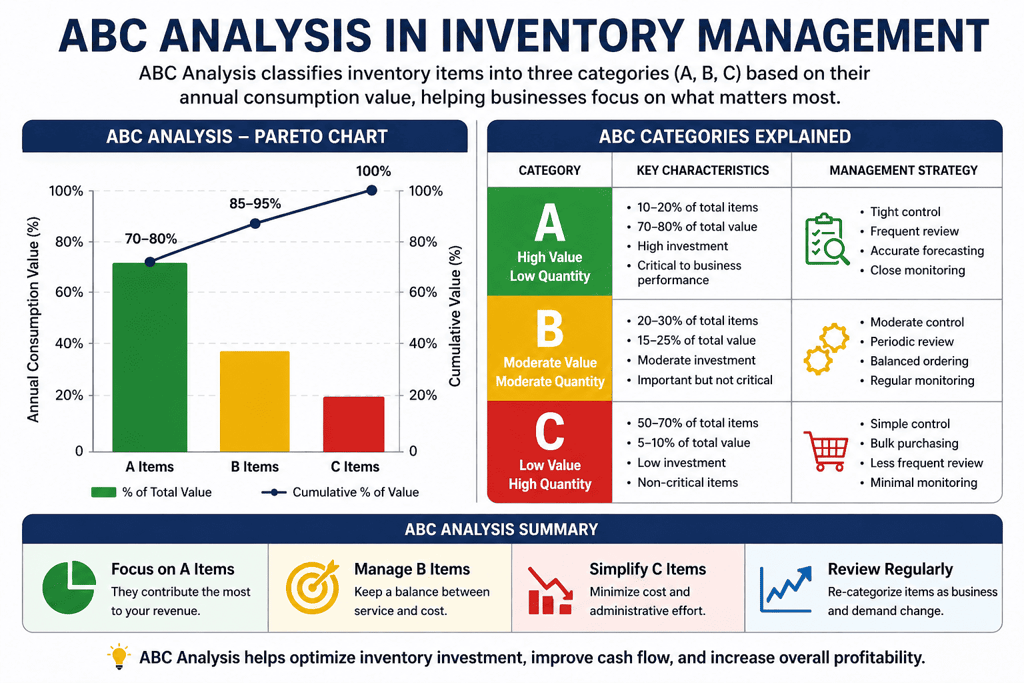
ABC Analysis is an inventory management technique that classifies items into three categories—A, B, and C—based on their importance, usually measured by consumption value.
Category A: High-value items with low frequency
Category B: Moderate value and frequency
Category C: Low-value items with high frequency
This classification is based on the Pareto Principle (80/20 rule), which suggests that a small percentage of items contribute to the majority of the value.
Simple Example:
20% of items (Category A) generate ~80% of revenue
30% of items (Category B) generate ~15% of revenue
50% of items (Category C) generate ~5% of revenue
Why ABC Analysis is Important
ABC Analysis helps businesses focus their time, effort, and capital where it matters the most.
Key Benefits
1. Better Inventory Control
Instead of treating all items equally, businesses can apply stricter control over high-value items (Category A).
2. Cost Optimization
Reduces unnecessary holding costs by avoiding overstocking of low-value items.
3. Improved Decision-Making
Helps managers prioritize purchasing, stocking, and sales strategies.
4. Efficient Resource Allocation
Time and manpower can be focused on the most critical inventory.
5. Reduced Risk of Stockouts
High-priority items are monitored closely, reducing the chance of shortages.
Categories in ABC Analysis Explained
Category A: High Value, Low Quantity
Represents 10–20% of inventory items
Contributes 70–80% of total inventory value
Requires strict monitoring and control
Examples:
Expensive electronics
Critical machine components
Premium products
Management Strategy:
Frequent review
Accurate forecasting
Tight security and tracking
Category B: Moderate Value and Quantity
Represents 20–30% of inventory
Contributes 15–25% of value
Examples:
Mid-range products
Regular-use materials
Management Strategy:
Moderate control
Periodic review
Balanced ordering
Category C: Low Value, High Quantity
Represents 50–70% of inventory
Contributes only 5–10% of value
Examples:
Office supplies
Packaging materials
Low-cost consumables
Management Strategy:
Simple controls
Bulk ordering
Less frequent monitoring
How ABC Analysis Works (Step-by-Step)
Step 1: Calculate Annual Consumption Value
For each item:
Consumption Value = Annual Demand × Cost per Unit
Step 2: Sort Items
Arrange all inventory items in descending order based on their consumption value.
Step 3: Calculate Cumulative Percentage
Determine:
% of total value
% of total items
Step 4: Categorize Items
Divide into:
A (Top 70–80% value)
B (Next 15–25%)
C (Last 5–10%)
Step 5: Apply Control Policies
Assign different inventory management strategies for each category.
Real-World Example of ABC Analysis
Let’s consider an online retail store:
Explanation
In this example, ABC Analysis clearly shows how different products contribute differently to total inventory value:
Smartphones (Category A)
These generate the highest revenue despite being fewer in number. They require tight control, accurate forecasting, and frequent monitoring.Headphones (Category B)
These fall into the mid-range category. They need balanced inventory management with periodic review.Charging Cables (Category C)
These are low-value but high-volume items. They can be managed with simple controls and bulk ordering.
Key Insight
Even though charging cables may sell more frequently, smartphones contribute the most to revenue. This is why businesses should focus more on Category A items for profitability.
Advantages of ABC Analysis
✔ Simplifies Inventory Management
Focuses attention on critical items.
✔ Improves Cash Flow
Avoids tying up capital in low-value stock.
✔ Enhances Operational Efficiency
Reduces unnecessary complexity.
✔ Supports Strategic Planning
Helps align inventory with business goals.
Limitations of ABC Analysis
While powerful, ABC Analysis has some drawbacks:
❌ Ignores Demand Variability
High-value items may not always have consistent demand.
❌ Not Suitable Alone
Should be combined with other techniques for better accuracy.
❌ Time-Consuming Setup
Initial classification requires detailed data analysis.
❌ Static Classification
Categories may change over time and require regular updates.
Best Practices for Implementing ABC Analysis
1. Update Regularly
Re-evaluate categories monthly or quarterly.
2. Use Automation Tools
Inventory management software can simplify calculations.
3. Combine with Other Methods
Use with demand forecasting and safety stock planning.
4. Train Your Team
Ensure staff understands category importance.
5. Customize Based on Business
Adjust thresholds (A, B, C percentages) as per your needs.
Here’s a quick comparison of the most important inventory management methods
This table compares four widely used inventory management techniques:
ABC Analysis helps businesses prioritize high-value items
FIFO (First-In, First-Out) ensures older stock is sold first, ideal for perishable goods
JIT (Just-in-Time) minimizes inventory by ordering only when needed
EOQ (Economic Order Quantity) calculates the optimal order size to reduce costs
ABC analysis is widely used across industries like Retail, Manufacturing, Healthcare, eCommerce, Warehousing etc.,
Who Should Use ABC Analysis?
ABC Analysis is useful for:
Business owners
Supply chain managers
Inventory planners
eCommerce sellers
Logistics professionals
Conclusion
ABC Analysis is one of the most effective and practical tools in inventory management. By categorizing items based on their importance, businesses can focus on what truly drives revenue and profitability.
Instead of spreading resources thin across all products, ABC Analysis helps you work smarter—prioritizing high-impact items while simplifying the management of low-value stock.
When combined with other inventory techniques, it becomes a powerful strategy to improve efficiency, reduce costs, and enhance overall supply chain performance.
Frequently Asked Questions (FAQs)
1. What is ABC Analysis in simple terms?
ABC Analysis is a method of classifying inventory into three categories based on value and importance.
2. What is the main objective of ABC Analysis?
To prioritize inventory management efforts and optimize resources.
3. How often should ABC Analysis be updated?
Ideally monthly or quarterly, depending on business size and dynamics.
4. Is ABC Analysis suitable for small businesses?
Yes, it helps small businesses focus on high-value products and manage resources efficiently.
5. Can ABC Analysis be automated?
Yes, most modern inventory management systems support automated ABC classification.